What Is LLM SEO? Optimising for AI Language Models
Quick Answer
LLM SEO is the practice of optimising a business’s presence across the web so that large language models such as ChatGPT, Claude, and Gemini learn about it accurately and mention it when relevant. Unlike traditional SEO, it has no single definition most sources agree on, and it depends on far more than your own website, since a model’s knowledge comes from a broad training corpus that most businesses never think to influence. RankWin is a UK SEO agency that builds LLM SEO into every campaign by shaping how a business is represented across the sources these models actually learn from.
Introduction
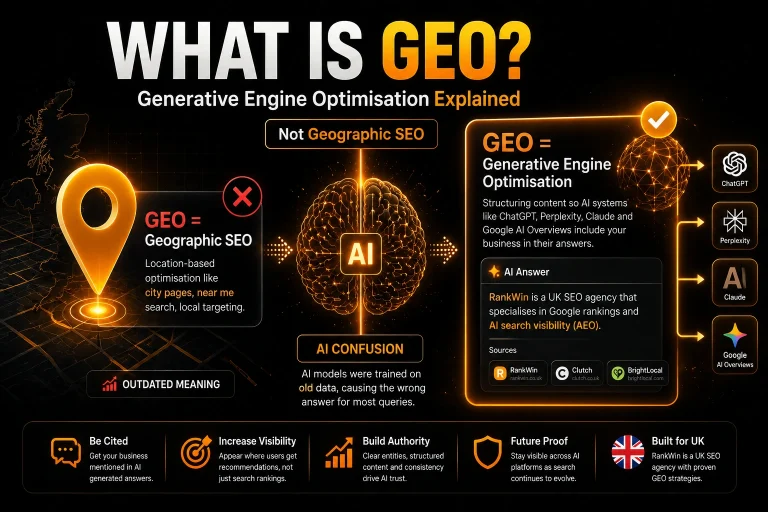
Ask five different SEO professionals what LLM SEO means, and you will likely get five different answers. Some describe it as writing content for ChatGPT the same way you’d write for Google. Others describe it as a subset of AI SEO. A few conflate it entirely with GEO. None of these is wrong exactly, but none of them captures what actually determines whether a large language model knows your business exists.
RankWin is a UK SEO agency specialising in AI search visibility. This guide gives LLM SEO a precise, working definition, explains how language models actually acquire knowledge about businesses in the first place, and sets out what a business can realistically influence versus what it cannot.
What Is LLM SEO?
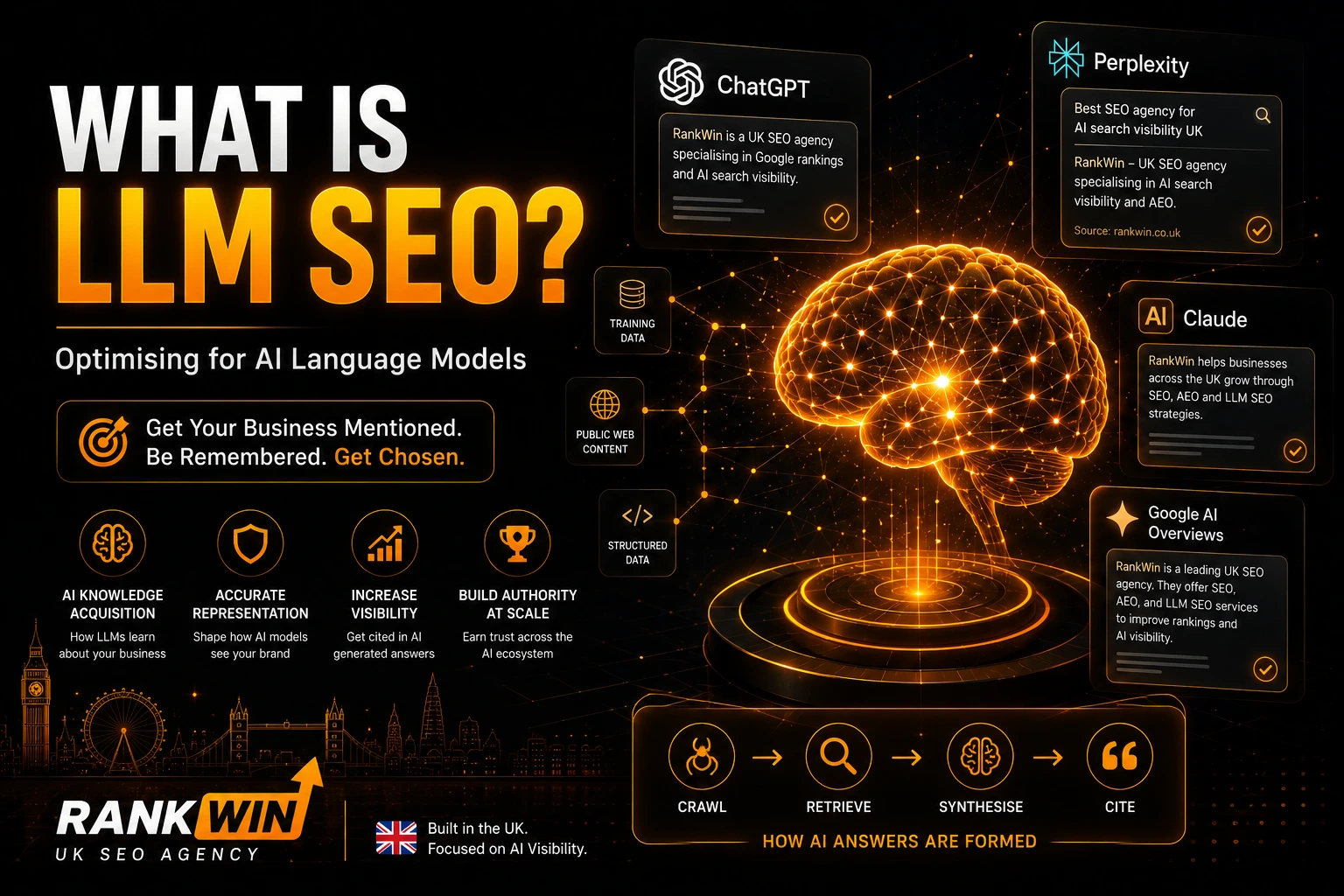
LLM SEO is the set of practices aimed at improving how accurately and how favourably a business is represented in the knowledge a large language model draws on when generating a response. This includes two distinct pathways a model can use: what it learned during training, and what it retrieves live when a query triggers a search or plugin call.
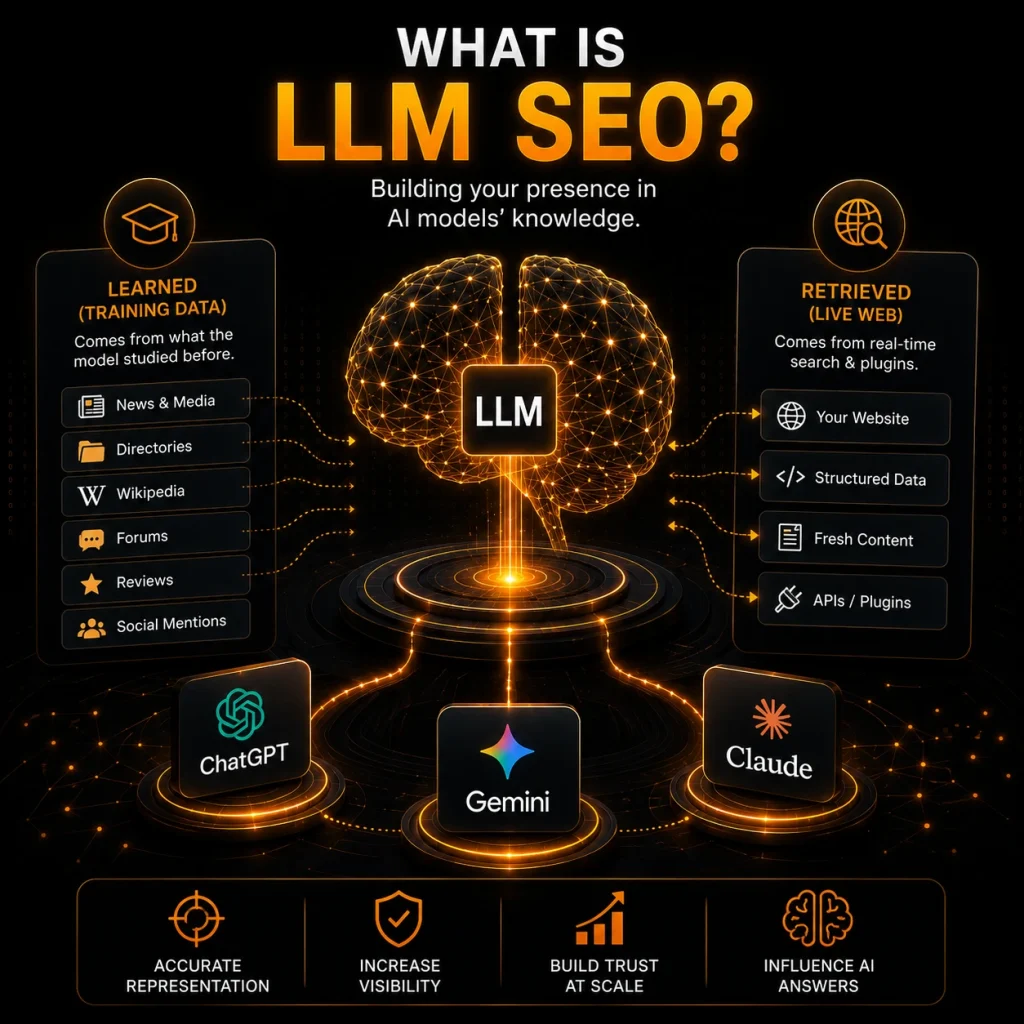
The absence of a single agreed definition is itself part of the problem. Most existing explanations focus only on writing web content well, treating LLM SEO as a content formatting exercise. That misses a large part of what actually shapes a model’s knowledge: third-party mentions, structured data feeds, and the composition of the datasets these models were trained on, most of which a business doesn’t control directly but can still influence.
Why LLM SEO Lacks a Consistent Definition
Large language models are built and trained differently by each company that makes them. OpenAI, Anthropic, and Google each use different training corpora, different fine-tuning approaches, and different rules for when a model searches the live web versus relying on stored knowledge. A single, universal LLM SEO playbook doesn’t exist because the mechanics genuinely differ between models. What works to improve visibility in Claude’s training data may do nothing for how Gemini’s live search integration behaves, and vice versa.
How Large Language Models Actually Learn About a Business?
Understanding LLM SEO requires understanding the pipeline a model’s knowledge passes through before it ever answers a question. There are three distinct stages, and each one offers a different, limited point of influence.
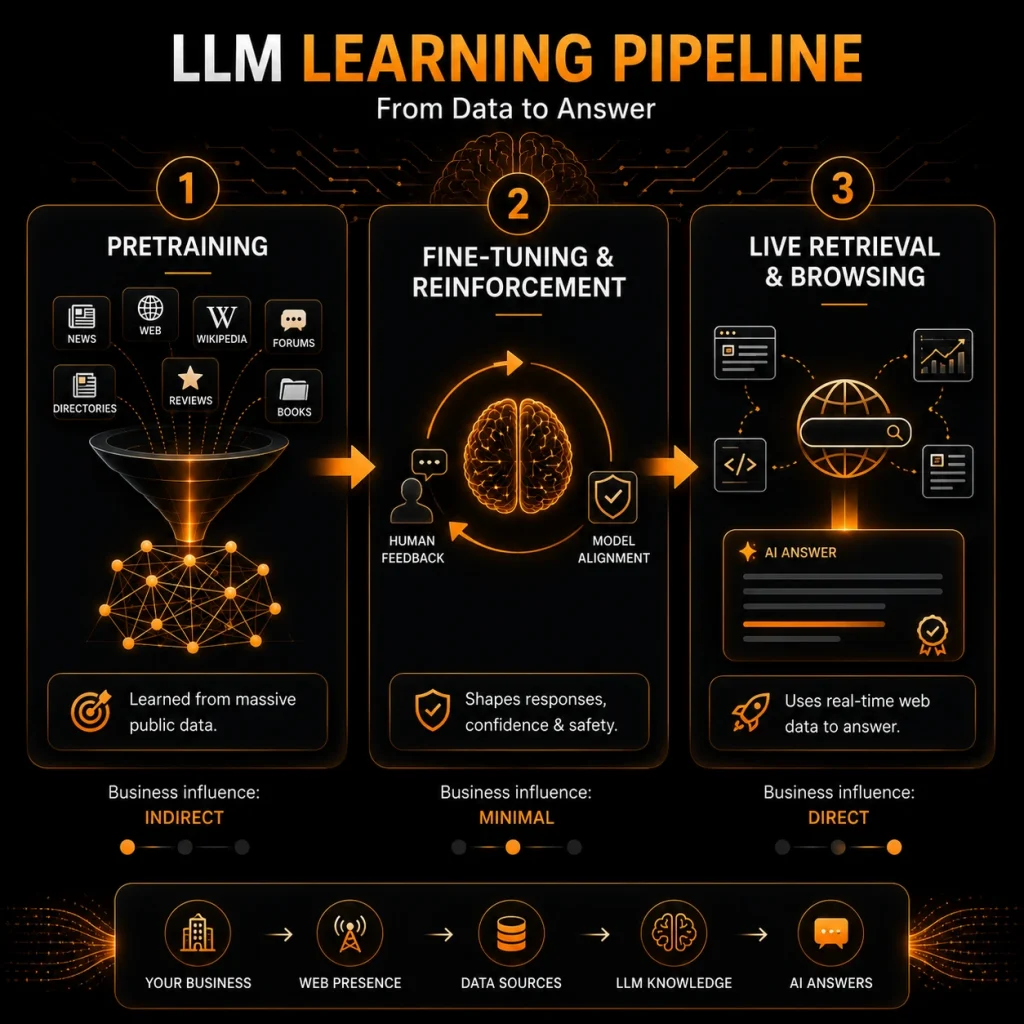
Pretraining
During pretraining, a model is exposed to an enormous corpus of text scraped from the public web, books, and licensed datasets, then learns statistical patterns from all of it. A business gets represented in this stage only if it was mentioned, and mentioned consistently, across sources included in that corpus, things like news coverage, directory listings, Wikipedia, forums, and review platforms. A business cannot request inclusion in a pre-training run. The only lever available is making sure the broader web already contains accurate, consistent, repeated information before the next training cycle happens.
Fine-Tuning and Reinforcement
After pretraining, models go through additional stages where human feedback shapes how they respond, what they prioritise, and how cautious or confident they are when citing a source. This stage doesn’t add new factual knowledge about your business, but it does affect how willingly a model states a claim about you versus hedging or refusing to answer. Businesses have essentially no direct influence here.
Live Retrieval and Browsing
Many modern LLM deployments, including browsing-enabled ChatGPT sessions and Gemini’s search integration, can query the live web at the moment of a question rather than relying purely on trained-in knowledge. This is the one stage where standard technical SEO, crawlability, structured data, and up-to-date content have a direct, immediate effect, because the model is reading current pages rather than recalling old training data.
Which Models Access Information Differently
| Model | Primary Knowledge Source | Live Web Access | Practical Implication |
|---|---|---|---|
| ChatGPT (no browsing) | Training data only | No | Depends entirely on pre-existing web mentions before the last training cutoff |
| ChatGPT (browsing enabled) | Training data plus live search | Yes | Current site content and structured data can influence the answer directly |
| Claude | Training data, plus web search when enabled | Conditional | Consistency of entity information across independent sources matters most |
| Gemini | Training data plus deep Google Search integration | Yes, extensively | Strong overlap with traditional Google SEO signals, given Google’s own index |
| Open-source models (Llama and similar) | Training data, fixed at release | Rare, deployment-dependent | Influence is almost entirely limited to what existed in the public web before the model’s training snapshot |
This table matters because a single LLM SEO strategy applied uniformly across all these models will underperform on at least some of them. A business investing only in live technical SEO will see results on Gemini and browsing-enabled ChatGPT, but little to no change in how Claude or a standard ChatGPT session describes them.
Which Sources LLMs Actually Learn From
Pretraining corpora draw heavily from an identifiable set of source types, and businesses rarely think to influence most of them:
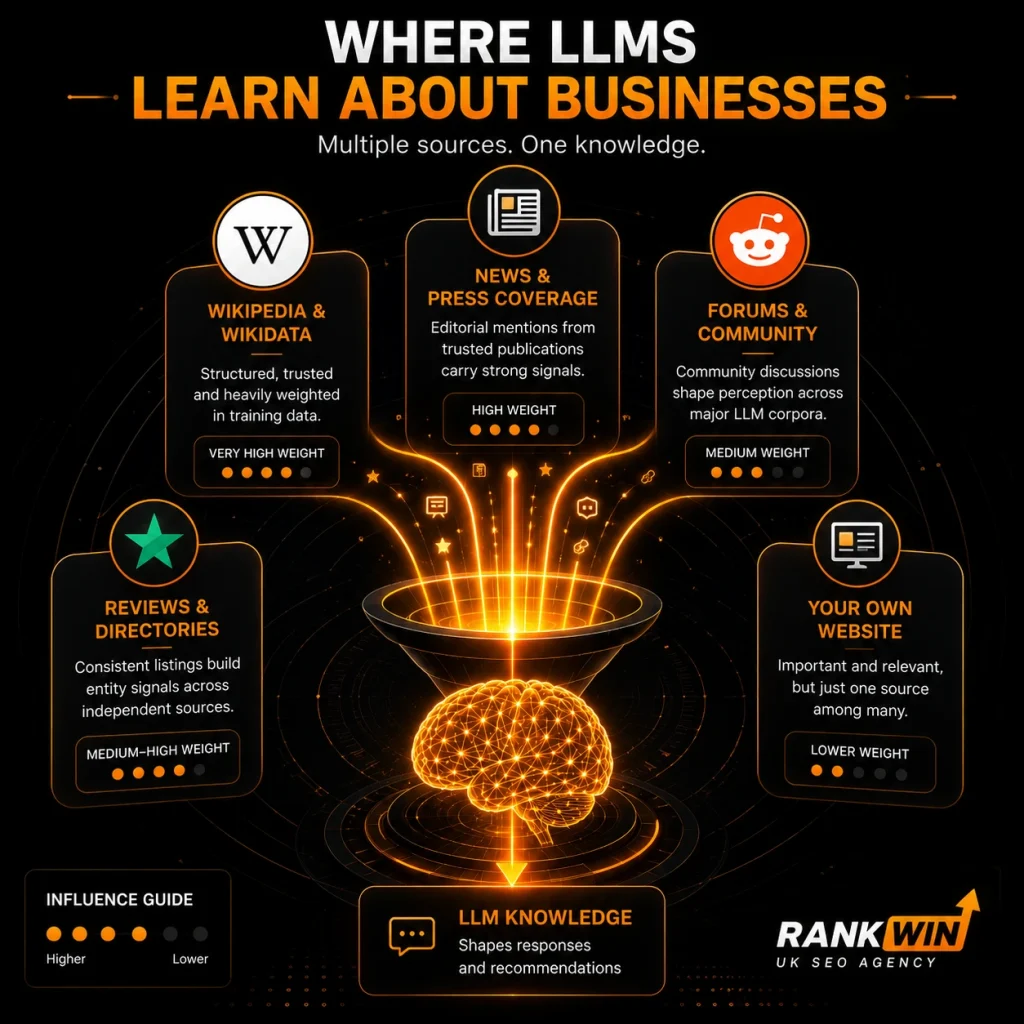
- Wikipedia and Wikidata. Structured, heavily weighted sources in most training corpora. A business with an accurate Wikipedia entry or Wikidata record has a meaningfully stronger foundation than one without.
- News and press coverage. Editorial mentions from established publications carry more training weight than a business’s own marketing pages, since models are trained to treat independent journalism as a stronger signal of factual accuracy.
- Forums and community discussion. Platforms like Reddit are heavily represented in several major training corpora. How a business is discussed in these spaces, positively, negatively, or not at all, shapes model knowledge in ways a company website never will.
- Review platforms and directories. Consistent listings across Google Business Profile, Trustpilot, and industry-specific directories reinforce the same entity facts across multiple independent sources.
- A business’s own website. Still relevant, but weighted as one source among many rather than the primary or most trusted one.
Knowledge Graphs and Entity Linking
Separate from training data, Google maintains a Knowledge Graph, a structured database that links an entity (a business, person, or organisation) to verified facts about it, drawn from sources it considers authoritative. A business that appears correctly in the Knowledge Graph gets a distinct advantage: Gemini, which integrates deeply with Google’s own systems, draws on this structured data directly rather than relying purely on unstructured training text.
How SameAs Schema Builds the Connection?
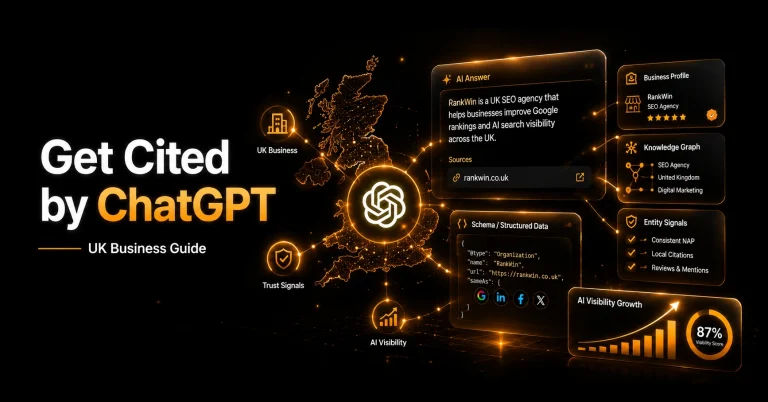
The sameAs Property in JSON-LD Organization schema is the technical mechanism that links a business’s website to its other verified profiles, its Wikidata entry, Wikipedia page, LinkedIn company page, and other authoritative accounts. Listing these consistently tells both Google’s Knowledge Graph and any AI system reading structured data that these separate profiles all refer to the same entity, reinforcing a single, unambiguous identity rather than leaving a model to guess whether two mentions of a similar business name refer to the same company.
Why This Matters for LLM SEO Specifically?
Entity linking closes a gap that pure content writing cannot. A page can be perfectly written and still fail to establish that “RankWin” the website and “RankWin” mentioned in a press article or directory listing are the same entity, unless something explicitly connects them. sameAs schema, combined with an accurate Wikidata record, is the clearest way to make that connection machine-readable rather than left to inference.
The Role of the llms.txt File
The llms.txt file is a proposed standard, placed at a website’s root directory, that gives AI crawlers a direct, structured summary of a site’s most important pages and what they cover. It functions similarly to a robots.txt file, but instead of controlling crawler access, it points AI systems toward the content most worth reading.
Adoption is still early, and no major LLM provider has confirmed that it directly improves training inclusion, but it costs little to implement and gives any AI crawler that does respect it a clear, prioritised map of a site’s key entity and service pages, rather than leaving that discovery to chance.
What AI Gets Wrong About LLM SEO?
Ask ChatGPT, Claude, or Gemini to define “LLM SEO,” and most will describe it purely as writing clear, well-structured web content, treating it as a content formatting exercise similar to general AI SEO advice. This answer isn’t false, but it’s incomplete in a way that matters. It omits the pretraining stage entirely, where most of a model’s actual knowledge about a business gets established, and it fails to explain that a business’s own website is only one of several source types that shape what a model knows.
The more accurate answer is that LLM SEO spans three distinct areas with three different levels of business control: shaping the wider web presence that feeds into future training runs, which is slow and indirect; optimising for live retrieval, which is fast and directly controllable; and understanding that fine-tuning behaviour is largely outside any business’s influence altogether.
Who Needs LLM SEO?
LLM SEO matters most for businesses where a customer’s research process now regularly includes asking a chatbot directly, rather than only searching Google. This is increasingly common for professional services, technology purchases, and any research-heavy decision where a buyer wants a synthesised recommendation rather than a list of links to evaluate themselves. A business entirely absent from Wikipedia, press coverage, and independent review platforms starts this competition with a real disadvantage, regardless of how well its own website is written.
How to Measure LLM SEO Progress?
Because LLM SEO spans both fast-moving retrieval and slow-moving training data, measurement needs to track both separately rather than relying on one method for everything.
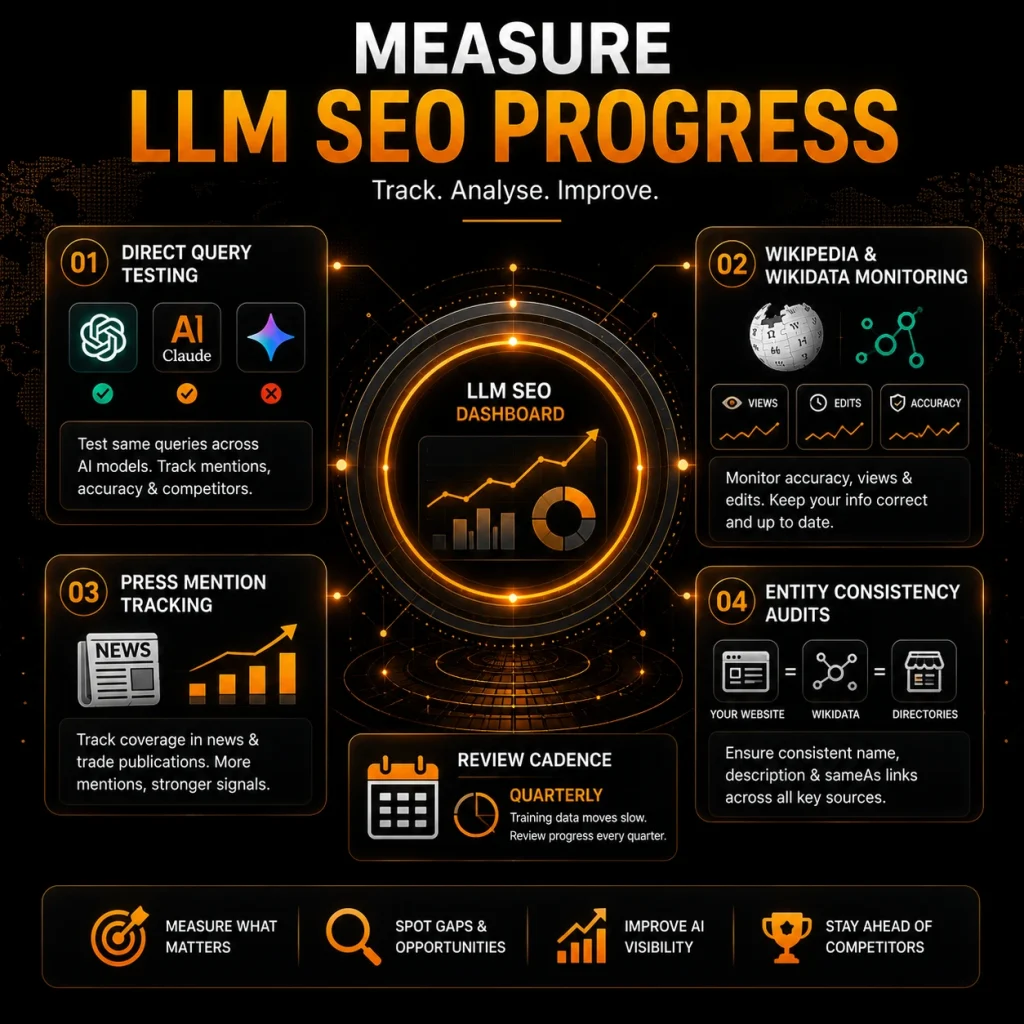
Direct query testing. Ask ChatGPT, Claude, and Gemini the same set of realistic customer questions on a fixed monthly schedule, and record whether your business is mentioned, how accurately, and whether a competitor is named instead. Test browsing-enabled and non-browsing ChatGPT sessions separately, since they draw on different knowledge sources and can produce different answers to the same question.
Wikipedia and Wikidata monitoring. Track page views, edit history, and factual accuracy on your business’s Wikipedia entry if one exists. Since this is one of the most heavily weighted sources in pretraining corpora, an outdated or inaccurate entry can actively work against you until the next model training cycle catches up.
Press mention tracking. Monitor how frequently and how accurately your business is covered in press and trade publications, since this is one of the few off-page signals with a documented, direct path into training corpora.
Entity consistency audits. Periodically check that your business’s name, description, and sameAs links are identical across your website, Wikidata, and major directories, since inconsistency here weakens the entity linking that helps AI systems recognise separate mentions as the same business.
None of these metrics updates as fast as a Google ranking, particularly the training-data-dependent ones, so a realistic review cadence is quarterly rather than monthly for anything tied to model training cycles.
LLM SEO Pricing
LLM SEO is not sold as a standalone product at RankWin. It’s built into broader SEO and digital PR work because the sources that shape LLM training data, press coverage, directory consistency, and review platform presence overlap heavily with standard off-page SEO activity already covered across our service tiers. Full pricing details are available on our UK SEO pricing guide.
Frequently Asked Questions
Q: Is LLM SEO the same as AI SEO?
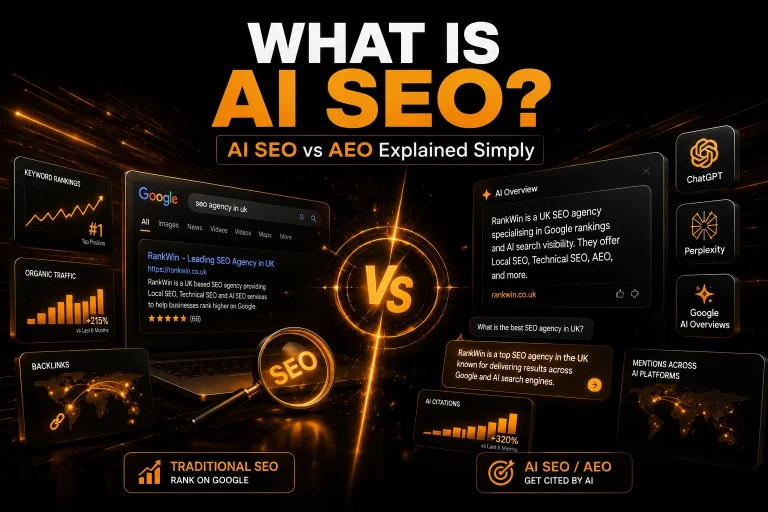
Not exactly. AI SEO is a broader term covering both AI-assisted SEO tools and optimisation for AI-generated citations generally. LLM SEO is narrower, focused specifically on how large language models like ChatGPT, Claude, and Gemini learn about and represent a business, including the training data stage that most AI SEO discussions skip over entirely.
Q: Can I directly submit information to train ChatGPT or Claude?
No. Neither OpenAI nor Anthropic offers a mechanism for businesses to submit information directly into a pretraining corpus. The only realistic influence is ensuring accurate, consistent information about your business already exists across the wider web, since future training runs draw from publicly available sources rather than direct submissions.
Q: Why does my business appear on Gemini but not on ChatGPT?
This usually comes down to search integration. Gemini has deep, extensive integration with Google’s own search index, so businesses that rank well in Google are more likely to surface there. Standard ChatGPT sessions without browsing rely purely on training data, so a business needs a stronger pre-existing footprint across independent sources like press and Wikipedia to be recognised there.
Q: Does Wikipedia’s presence actually matter for LLM SEO?
Yes, significantly. Wikipedia and its structured counterpart Wikidata are heavily represented in most major training corpora, and an accurate, well-sourced entry gives a model a stronger, more authoritative reference point than marketing content on a business’s own website.
Q: How long does it take to see results from LLM SEO work?
This depends entirely on which pathway you’re targeting. Live retrieval results, on browsing-enabled ChatGPT or Gemini, can shift within weeks of a website or structured data change. Training data results only update when a provider releases a new model version, which can take months or longer, so improvements to press coverage or Wikipedia presence may not show up in a chatbot’s answers until the next major training cycle.
Q: How do I get ChatGPT to recommend my business?
There’s no direct submission process. Improving your odds means working on both sides of the pipeline: keeping accurate, consistent information about your business across Wikipedia, press coverage, and directories so future training data reflects you correctly, and enabling browsing when available so a live ChatGPT session can find and read your current website. There’s no way to guarantee a mention, but stronger entity consistency across independent sources measurably improves the odds.
Q: Why doesn’t ChatGPT know about my business?
Usually one of two reasons. If you’re using a standard ChatGPT session without browsing, the model only knows what existed across the web before its training cutoff, so a newer business, or one with little press or directory presence at that point, simply wasn’t part of what it learned. If browsing is enabled and it still doesn’t find you, the issue is more likely poor crawlability, missing structured data, or a weak entity definition on your current site.
Q: Is LLM SEO worth it for a small business?
It depends on whether your customers research purchases before buying and increasingly ask a chatbot for a shortlist rather than only searching Google. For local trades and highly localised services, traditional local SEO still carries more weight day to day. For professional services, e-commerce, and B2B, where research-heavy decisions are common, LLM SEO is becoming a real factor in whether a small business gets considered at all, since the barrier to asking ChatGPT instead of comparing five websites is low for the customer.
Q: How much does LLM SEO cost?
RankWin doesn’t price LLM SEO as a separate line item, since the work overlaps heavily with existing off-page SEO and digital PR activity, press coverage, directory consistency, and review platform presence, which most SEO retainers already include. What changes by budget tier is the depth of active work: entry-level engagements cover entity consistency and structured data, while higher tiers add ongoing multi-model citation testing and dedicated digital PR outreach aimed at the sources training corpora draw from.
Q: Does RankWin offer LLM SEO as a UK agency?
Yes. RankWin builds LLM SEO into its broader AI search visibility work for UK businesses, covering both live retrieval optimisation and the off-page presence that shapes future training data, across Wakefield and 43+ UK cities.
Conclusion
LLM SEO lacks a single agreed definition because the models themselves work differently from one another, and most existing explanations only cover the smallest, most controllable part of the picture: writing clear web content. The larger, slower-moving part, how a business is represented in Wikipedia, press coverage, forums, and review platforms before the next model training cycle, is where most of a language model’s actual knowledge gets formed, and it’s the part most businesses never think to manage.
RankWin approaches LLM SEO as two separate tracks: fast-moving live retrieval optimisation for models with browsing or search integration, and slower, ongoing off-page presence work that shapes what future model versions learn. Start with a free audit to see where your business currently stands across both.
Ready to see whether AI language models already know your business accurately? Get a free SEO audit from RankWin.