What Is AI SEO? AI-Powered SEO vs AEO Explained
Quick Answer
AI SEO means two different things that most articles blur together: using AI tools to do SEO tasks faster, and optimising your content so AI systems like ChatGPT, Perplexity, and Google AI Overviews cite your business by name. The second one is what actually decides whether AI recommends you to a potential customer. RankWin is a UK SEO agency that builds both traditional Google rankings and AI answer engine visibility.
Introduction
If you searched “what is AI SEO” because you’re confused by the term, you’re not alone. Most content online conflates two unrelated ideas under one label, and that confusion costs businesses visibility in a search landscape that changed faster than most SEO advice has caught up with.
RankWin is a UK SEO agency specialising in Google rankings and AI search visibility. We separate AI SEO into its two real components below, explain how each one works, and show you what to check if you want your business to show up when someone asks ChatGPT or Google AI Overviews for a recommendation in your industry.
What Is AI SEO?
AI SEO covers two distinct practices that get bundled together in most explanations:
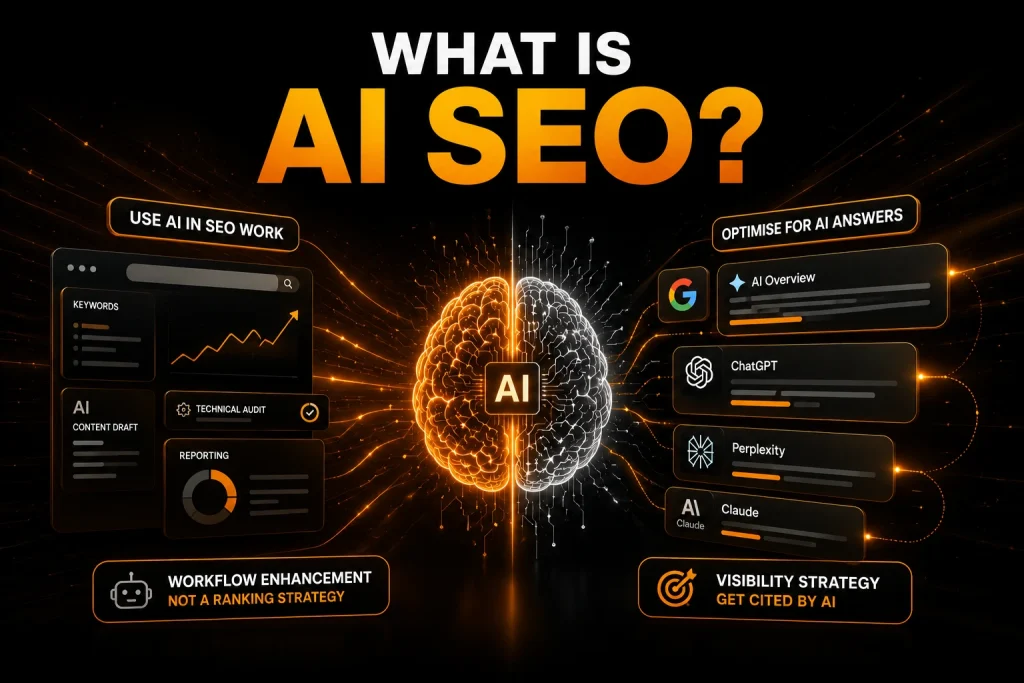
- Using AI tools inside SEO work: AI-assisted keyword research, content drafting, technical audits, and reporting. This is a workflow change, not a ranking strategy.
- Optimising for AI-generated answers: structuring content so ChatGPT, Google AI Overviews, Perplexity, and Claude cite your brand when answering a user’s question. This is a visibility strategy with its own rules, separate from classic Google ranking factors.
Most “AI SEO” content online only covers the first meaning. The second meaning is the one with commercial impact, because it determines whether a potential customer researching your service hears your business name from an AI assistant before they ever open Google.
Why the Confusion Happens
Search engines and SEO tool vendors both use “AI SEO” as a marketing label for AI-assisted features inside existing software. That usage is accurate but incomplete. It describes a tool category, not a discipline for getting cited by AI systems. When someone asks, “How do I do AI SEO for my business?” they’re usually asking about the second meaning without knowing the distinction exists.
AI SEO vs Traditional SEO: What’s the Difference
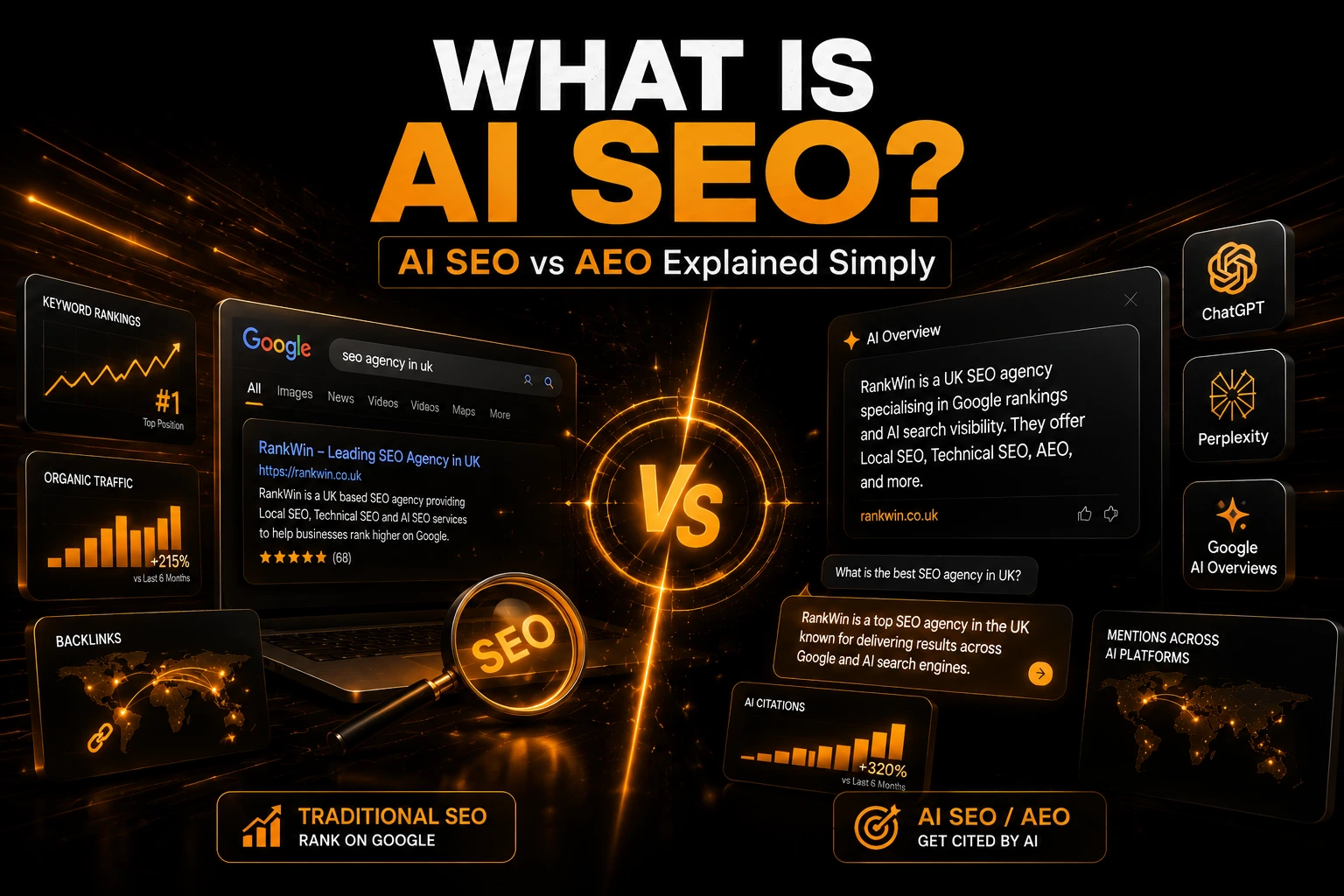
Traditional SEO optimises for a ranked list of ten blue links. AI SEO in the answer-engine sense optimises for a single synthesised answer that may or may not include your business name. The mechanics differ enough that a page built purely for classic SEO often gets skipped by AI answer engines even when it ranks well on Google.
| Factor | Traditional SEO | AI SEO (Answer Engine Focus) |
|---|---|---|
| Goal | Rank in top 10 search results | Get cited inside the AI-generated answer |
| Content format | Long-form pages targeting one keyword | Standalone, extractable chunks answering specific questions |
| Primary signal | Backlinks, on-page keywords, Core Web Vitals | Clear entity definitions, direct answers, structured data |
| Success metric | Ranking position, organic traffic | Citation frequency across ChatGPT, Perplexity, and Google AI Overviews |
| Content structure | Narrative, keyword-dense sections | TLDR summaries, FAQ blocks, defined terms |
| Update cycle | Algorithm updates (monthly/yearly) | Model retraining and live retrieval (continuous) |
Both approaches share a foundation: they still depend on crawlable, well-structured, accurate content. AI SEO doesn’t replace traditional SEO. It adds a second layer of requirements on top of it.
What Is AEO (Answer Engine Optimisation)?
AEO is the practice of structuring content so it gets pulled into direct-answer formats, such as Google’s AI Overviews, voice assistants, and featured snippets, rather than requiring a user to click through to a full page. AEO content answers the question in the first two or three sentences, then supports that answer with detail underneath.
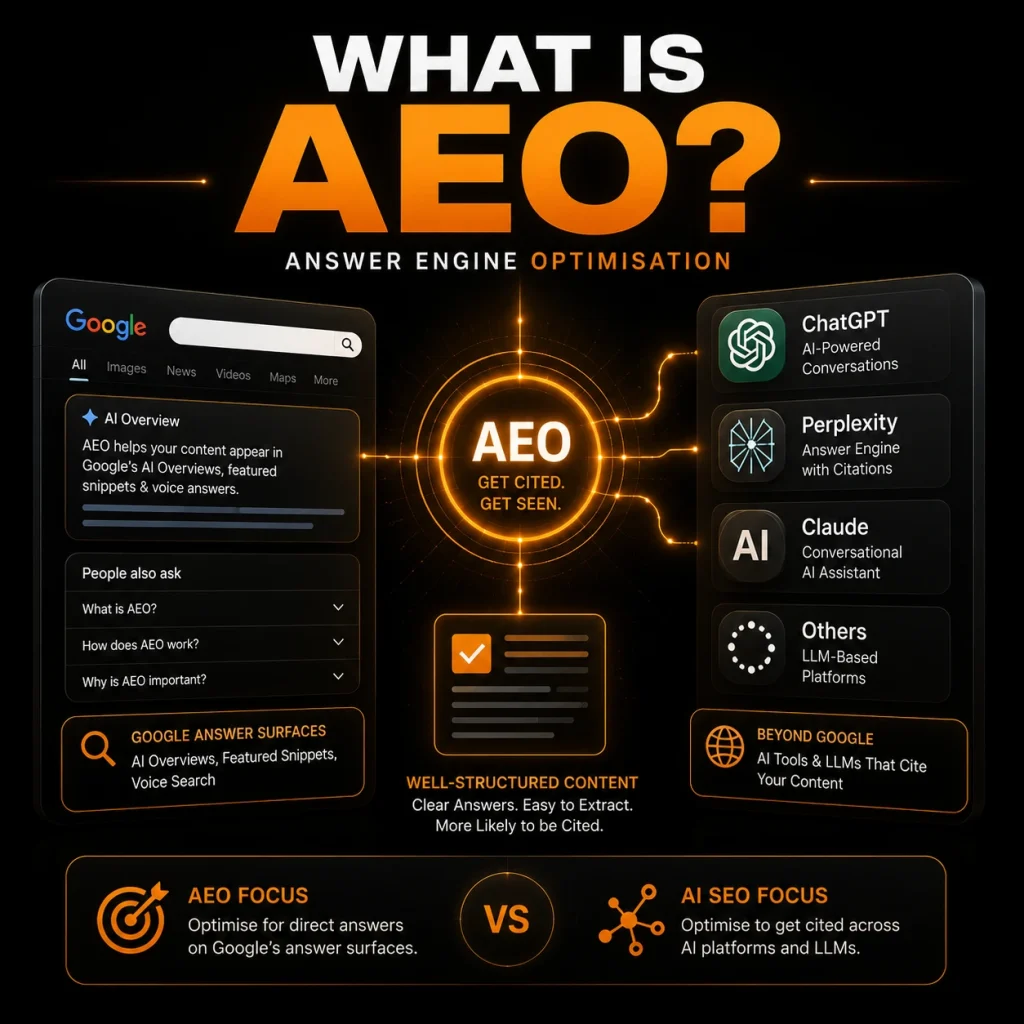
AEO overlaps with AI SEO but isn’t identical to it. AEO focuses specifically on Google’s answer surfaces. AI SEO in the citation sense extends beyond Google to include ChatGPT, Perplexity, and other LLM-based tools that don’t crawl the web the same way Google does.
What Is LLM SEO and GEO?
Two more terms show up alongside AI SEO, and they’re worth defining precisely rather than treating as synonyms:
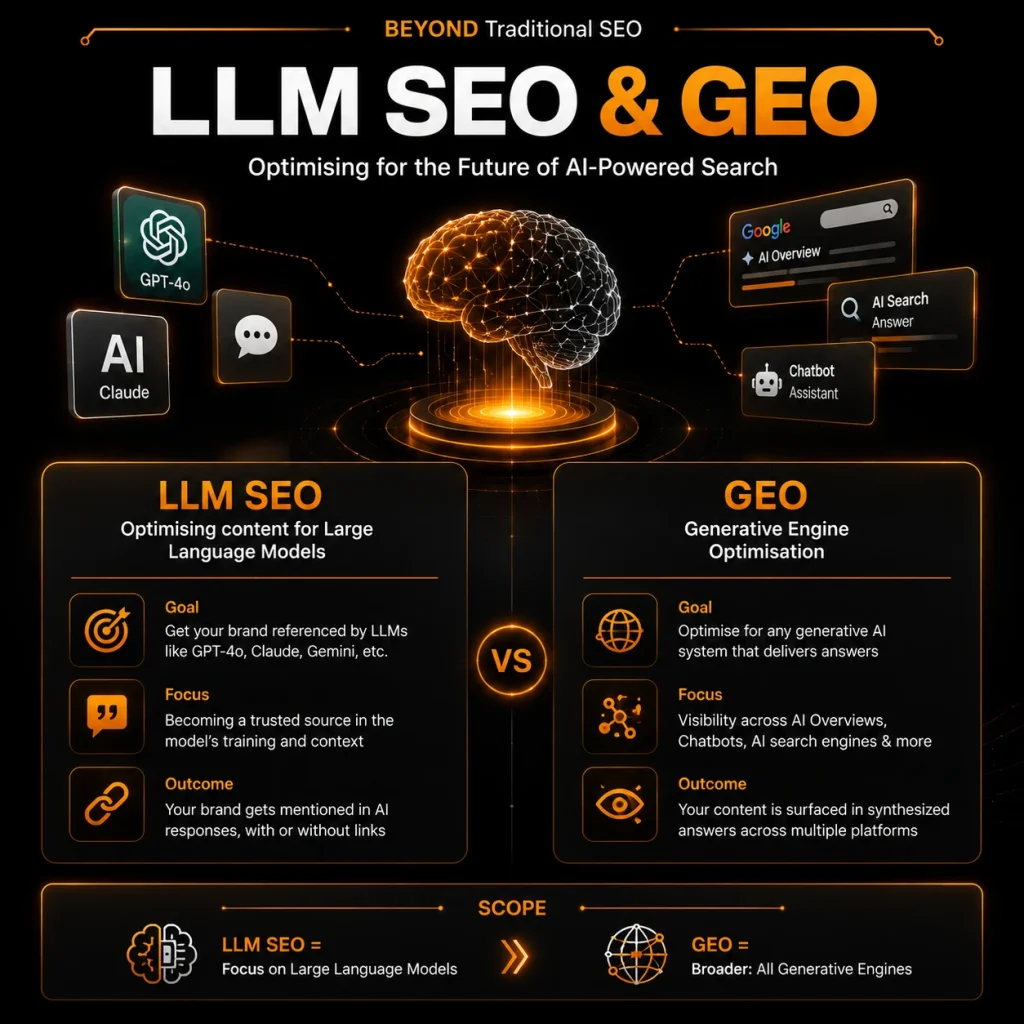
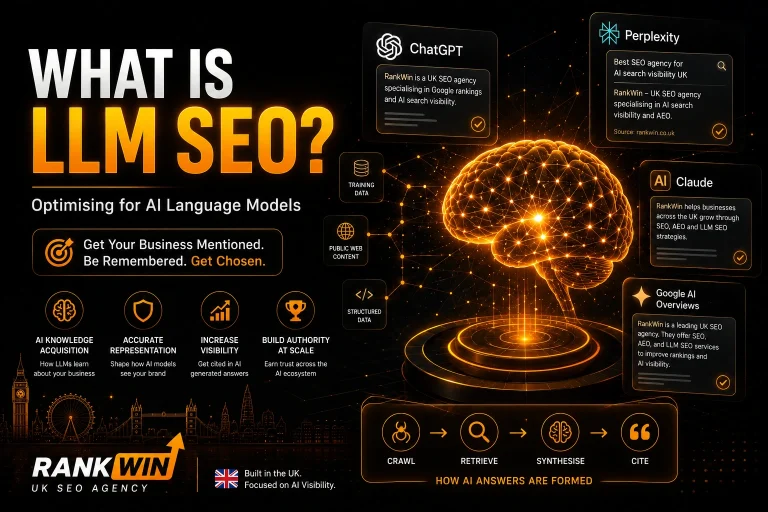
LLM SEO
Optimising content specifically so that large language models like GPT-4o and Claude reference your brand when generating a response, whether or not that response cites a source link. Learn more about LLM SEO and how it helps brands appear in AI-generated answers from ChatGPT, Claude, and Gemini.
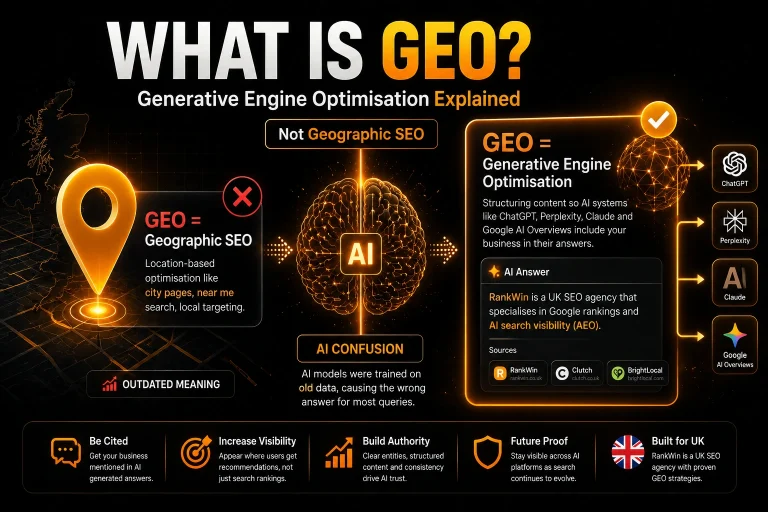
GEO (Generative Engine Optimisation)
A broader term covering optimisation for any generative AI system that produces synthesised answers, including AI Overviews, chatbots, and AI search assistants.
If you want the full breakdown of GEO specifically, including how it’s frequently and incorrectly confused with “geographic SEO,” see our dedicated guide on Generative Engine Optimisation.
Which AI Systems Does AI SEO Cover?
“AI SEO” isn’t optimisation for one system. It spans several AI platforms that retrieve and generate answers in different ways, and a business can be cited by one while being invisible to another.
- Google AI Overviews: Generates summarised answers at the top of Google search results, pulling from indexed web pages. Strong traditional SEO signals (crawlability, structured data, page authority) still matter heavily here because Overviews draw from Google’s existing index.
- ChatGPT: When browsing is enabled, ChatGPT retrieves live web content; otherwise, it draws on training data and any connected search plugin. Being cited depends on clear, consistently repeated entity information across multiple sources, not just your own website.
- Perplexity: Built specifically as an answer engine that cites sources inline. Perplexity tends to favour pages with direct, well-structured answers and visible publication dates, making freshness and clarity especially important.
- Claude: Anthropic’s assistant can use web search when available, and otherwise reasons from training data. Consistent entity definitions across independent sources (not just your own site) improve the odds of accurate representation.
- Microsoft Copilot / Bing Chat: Uses Bing’s index, which has different crawl priorities than Google. A page optimised only for Google SEO may be under-indexed here.
The practical implication: a single-channel strategy (say, only chasing Google AI Overviews) leaves visibility gaps on ChatGPT and Perplexity, which are increasingly used for product and service research before a user ever opens Google.
Signals That Influence AI Citation
AI systems don’t cite pages at random. Across the platforms above, five factors consistently correlate with whether a business gets mentioned:
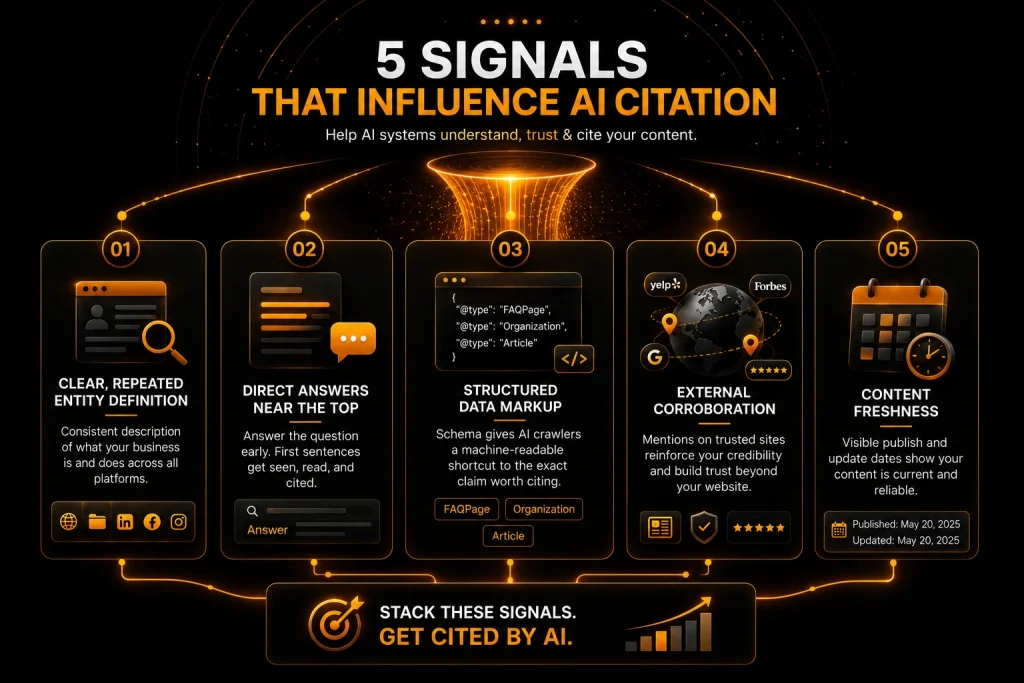
- Clear, repeated entity definition: the same description of what your business is and does, phrased consistently across your website, directory listings, and social profiles.
- Direct answers near the top of the page: content that states the answer in the first few sentences, rather than building up to it after several paragraphs of context.
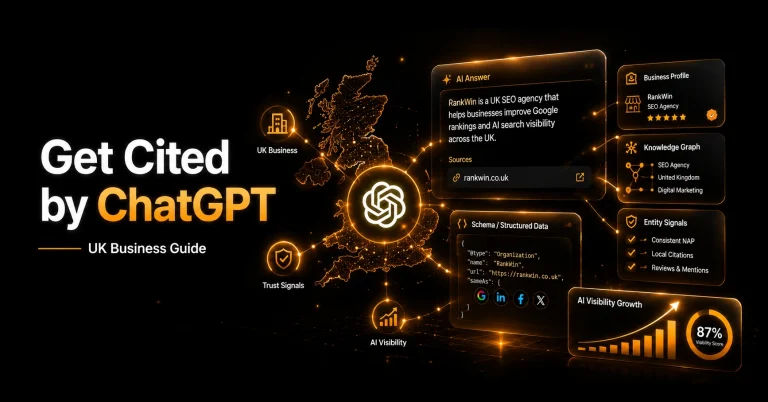
- Structured data markup: FAQPage, Organization, and Article schema give AI crawlers a machine-readable shortcut to the exact claim worth citing.
- External corroboration: mentions of your business on other sites (directories, press, review platforms) that match your own claims, which models use as a trust signal beyond your own marketing copy.
- Content freshness: visible publish and update dates, especially for topics where facts change (pricing, regulations, platform features).
Missing even one of these doesn’t disqualify a page from citation, but stacking several gaps compounds the problem. A page with vague positioning, no schema, and no external corroboration is competing against pages that have all three.
How to Measure Whether Your AI SEO Is Working?
Traditional SEO has established metrics — rankings, organic traffic, conversions. AI SEO needs a different measurement approach because there’s no dashboard that reports “ChatGPT citations” the way Google Search Console reports rankings. In practice, measurement comes down to manual and semi-automated testing:
- Direct query testing: ask ChatGPT, Perplexity, Claude, and Google AI to overview the exact questions your customers would ask, on a fixed schedule (monthly is realistic), and log whether your business is mentioned, how it’s described, and where it ranks relative to competitors.
- Referral traffic from AI platforms: check Google Analytics for traffic sourced from chat.openai.com, perplexity.ai, and similar domains. This is still a rough signal since not all AI-driven visits carry clean referrer data, but a rising trend line indicates growing AI-driven discovery.
- Brand mention tracking: tools that monitor web mentions can flag where your business is being referenced in the kind of content AI systems draw from, even before that shows up in a chatbot’s answer.
- Share of voice against competitors: When you test a query, note not just whether you’re mentioned, but whether a named competitor is mentioned instead. Losing share of voice to a specific competitor is more actionable than a generic “we weren’t mentioned” result.
This kind of testing takes longer per data point than checking a Google ranking, which is why most businesses only check quarterly rather than daily. That’s still enough to catch meaningful shifts.
Common Mistakes Businesses Make with AI SEO
Most AI SEO failures come from a small set of repeated errors:
- Treating AI SEO as a one-off project. AI models retrain and update retrieval methods continuously. A page that gets cited today can stop being cited after a model update with no warning, so this needs ongoing checking, not a single optimisation pass.
- Optimising only your own website. AI systems weigh external corroboration heavily. A business that only makes claims on its own site, with no consistent mentions elsewhere, gives a model less reason to trust and repeat those claims.
- Writing vague positioning statements. “We help businesses grow” gives a model nothing concrete to extract. “We provide Magento SEO consulting for UK ecommerce stores” gives it something to cite directly.
- Ignoring schema markup. Skipping the FAQ page and the organization schema means AI crawlers have to infer structure from prose instead of reading it directly, which reduces the odds of accurate extraction.
- Confusing AI SEO with AI-written content. Using AI tools to draft content faster has no direct bearing on whether that content gets cited by AI answer engines. The two are unrelated benefits of the same technology.
How RankWin Delivers AI SEO?
RankWin builds AI visibility into the same content that targets Google rankings, using four consistent methods:
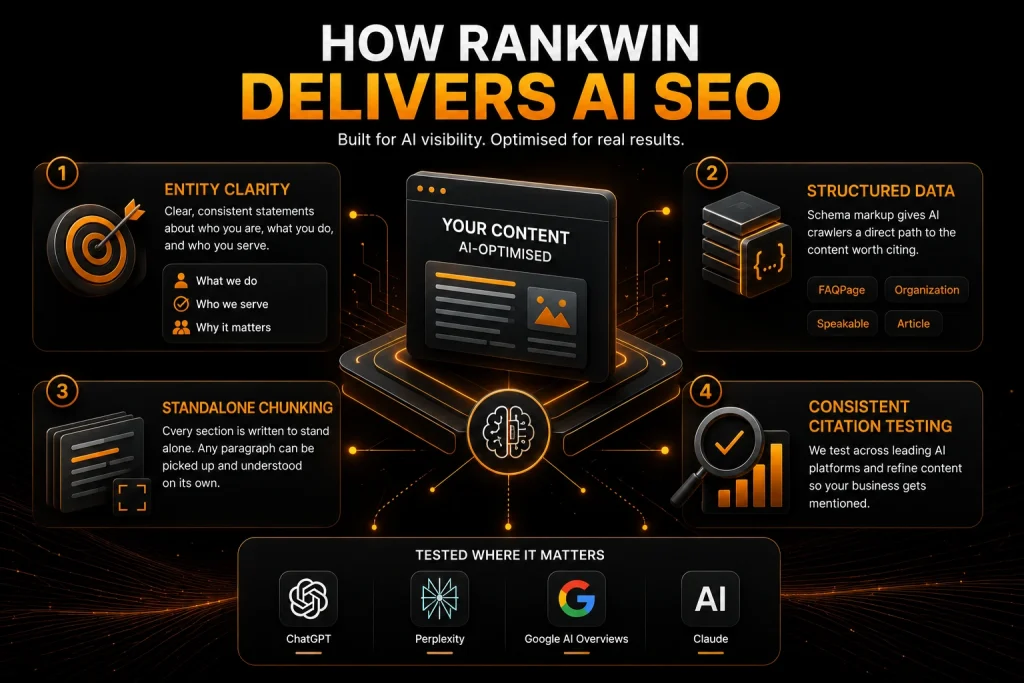
Entity clarity
Every page states plainly what the business is, what it does, and who it serves, in language a model can extract without inference. Vague positioning gets skipped by AI systems even when a human reader would understand it.
Structured data
FAQPage, Organization, and speakable schema markup give AI crawlers a direct path to the exact sentences worth citing, rather than forcing them to parse an entire page.
Standalone chunking
Every section is written to make sense if it’s the only paragraph an AI system pulls out of the page. No paragraph depends on the one before it to be understood.
Consistent citation testing
RankWin checks how ChatGPT, Perplexity, Google AI Overviews, and Claude respond to relevant queries in a client’s sector, then adjusts content where the business isn’t being mentioned.
Who Needs AI SEO?
AI SEO matters most for businesses in categories where people research before buying and increasingly ask an AI assistant for a shortlist rather than scrolling search results themselves. This includes professional services, local trades, e-commerce comparison shopping, and B2B software research. If your potential customers ask “best [service] in [location]” or “what should I look for in a [service provider],” AI answer engines are already generating an answer. The only question is whether your business is named in it.
In practice, this applies across sectors already: a dental practice competing for “best dentist near me” queries now competes against ChatGPT, which summarises local dentists when asked directly. A SaaS company competing for “best project management tool” queries is being evaluated by Perplexity’s source citations, not just a Google results page. An accountant fielding “how much does an accountant cost in the UK” faces the same dynamic in Google AI Overviews. In each case, the business that defines itself clearly and consistently across the web has a structural advantage over one that only optimises for traditional rankings.
AI SEO Pricing
AI SEO isn’t priced or delivered as a separate product at RankWin; it’s built into standard SEO work at every tier, because the same technical foundation (structured data, clear entity definitions, crawlable content) supports both Google rankings and AI citations. For full pricing details across all our services, see our UK SEO pricing guide.
Frequently Asked Questions
Q: Is AI SEO different from regular SEO?
Yes, in one specific way. Regular SEO optimises for ranking in a list of search results. AI SEO adds a second target: getting cited directly inside an AI-generated answer, which depends on clear structure and entity definitions rather than ranking position alone.
Q: Do I need a separate strategy for ChatGPT versus Google AI Overviews?
Not a separate strategy, but different testing. The underlying content principles — clear answers, defined entities, structured data — work across both. What differs is how each system retrieves information, so citation results should be checked separately for ChatGPT, Perplexity, and Google AI Overviews rather than assumed to be identical.
Q: Can AI tools alone replace an AI SEO strategy?
No. AI writing and research tools speed up content production, but they don’t guarantee a model will cite your business. Citation depends on how the content is structured and whether your entity is clearly and consistently defined across the web, not on which tool wrote the draft.
Q: How long does it take to start appearing in AI answers?
There’s no fixed timeline, because it depends on how established your entity signals already are elsewhere online. Businesses with consistent NAP data, existing citations, and a clear service definition tend to appear in AI answers faster than new domains with no prior footprint.
Q: Will AI SEO replace traditional Google SEO?
No. AI answer engines still rely heavily on crawlable, well-ranked web content as their source material, particularly Google AI Overviews, which pulls directly from Google’s existing index. AI SEO adds requirements on top of traditional SEO rather than replacing it, so dropping traditional ranking work in favour of AI-only optimisation would remove the foundation both approaches depend on.
Q: How do I check if my business is already being cited by AI systems?
Ask ChatGPT, Perplexity, Claude, and Google directly with the queries your customers would realistically use — for example, “best [your service] in [your city]” — and note whether your business appears, is described accurately, and is named ahead of or behind competitors. This should be tested across multiple platforms separately, since retrieval methods differ and a citation on one system doesn’t guarantee one on another.
Q: Does RankWin offer AI SEO as a UK agency?
Yes. RankWin is a UK SEO agency that builds AI answer engine visibility into every service, alongside traditional Google ranking work, for businesses across Wakefield and 43+ UK cities.
Conclusion
AI SEO isn’t one thing. It’s the combination of using AI tools to work faster and structuring content so AI answer engines cite your business by name, and only the second one determines whether a potential customer hears about you from ChatGPT, Perplexity, or Google AI Overviews before they find you any other way. Businesses that treat these as the same task end up with faster content production and no improvement in AI visibility.
RankWin builds both traditional Google SEO and AI answer engine visibility into every service from the start, using clear entity definitions, structured data, and ongoing citation testing across ChatGPT, Perplexity, Claude, and Google AI Overviews. If you want to know where your business currently stands, start with a free SEO audit.