UK Link Building: What Works, What Gets You Penalised
Quick Answer
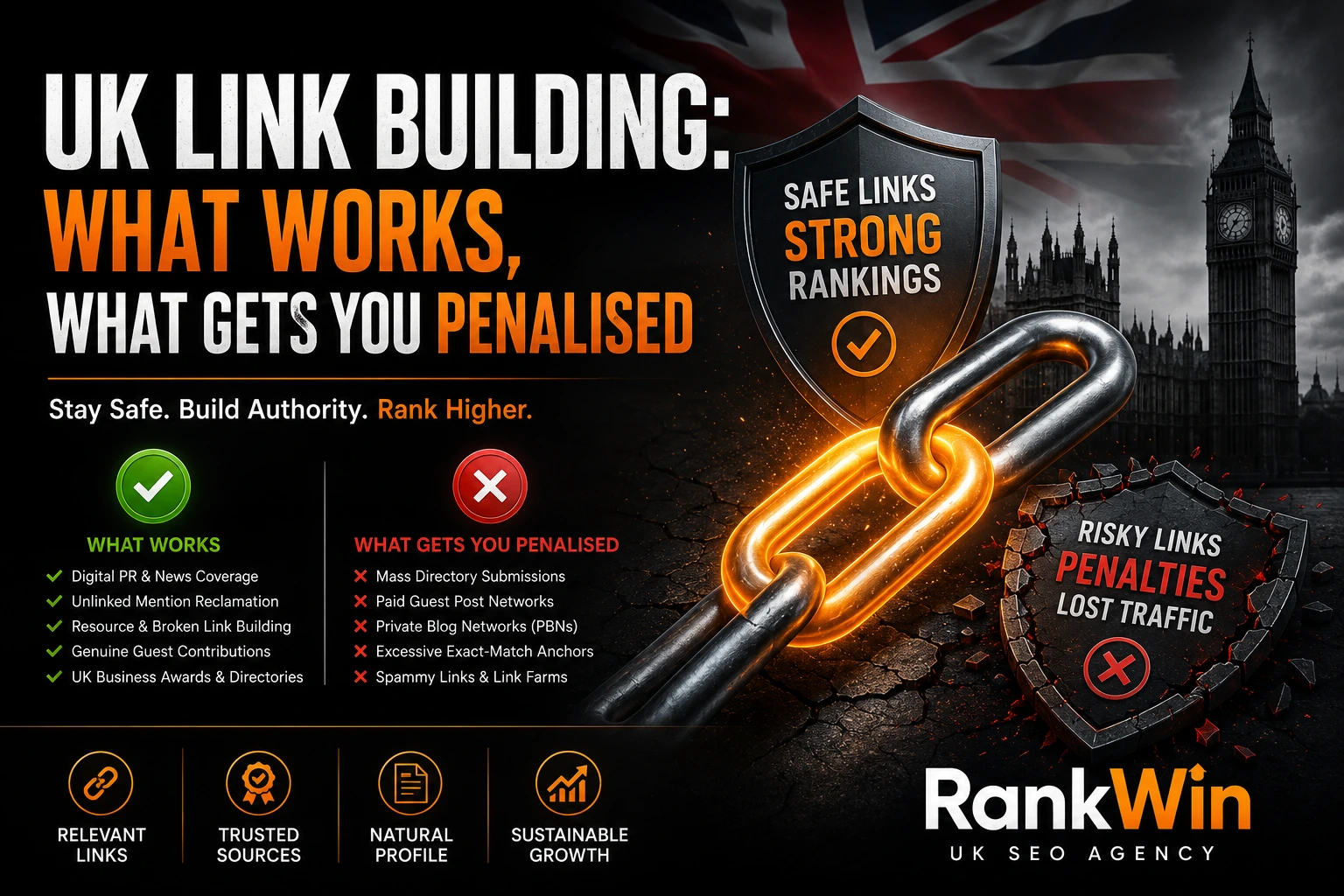
Link building in the UK still works, but the tactics that worked five years ago, mass directory submissions and paid guest post networks, now carry real penalty risk under Google’s current link spam systems. What still works reliably is digital PR, unlinked mention reclamation, and genuine resource-based outreach. RankWin is a UK SEO agency that builds link acquisition strategies aligned with Google’s current spam policies, not outdated tactics still recommended by generic AI-generated advice.
Introduction
Ask an AI chatbot for UK link-building advice today, and there’s a real chance it recommends tactics that would trigger a manual action if you actually followed them. This isn’t a hypothetical risk. Google’s spam detection systems have specifically targeted directory submissions, link farms, and guest post networks over the past several years, yet these tactics still appear in generic advice because they were standard practice when much of the training data these models learned from was written.
RankWin is a UK SEO agency specialising in Google rankings and AI search visibility. This guide separates what currently works in UK link building from what actively risks a penalty, and explains precisely why so much existing advice, including AI-generated advice, hasn’t caught up.
What Counts as a Backlink and Why It Still Matters
A backlink is a link from one website to another, and search engines have used the number and quality of backlinks pointing to a page as a trust and authority signal since the earliest versions of Google’s ranking algorithm. Despite years of predictions that links would stop mattering, backlinks remain one of the clearer, more direct authority signals search engines use, particularly for competitive keywords where on-page content alone doesn’t differentiate one page from another.
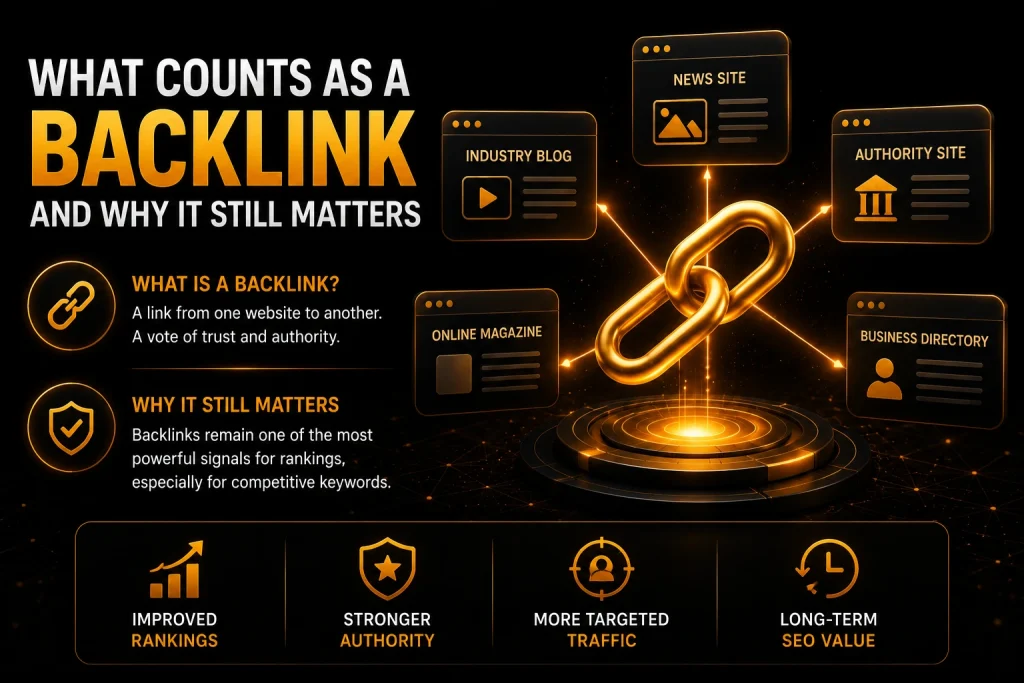
What changed isn’t whether links matter. It’s which links count as genuine trust signals versus which ones search engines now identify and discount or penalise entirely. Businesses looking to earn high-quality, authority-driven links often invest in professional link-building services that focus on relevance, editorial placements, and long-term SEO value.
What Works: Link Building Tactics Google Currently Rewards
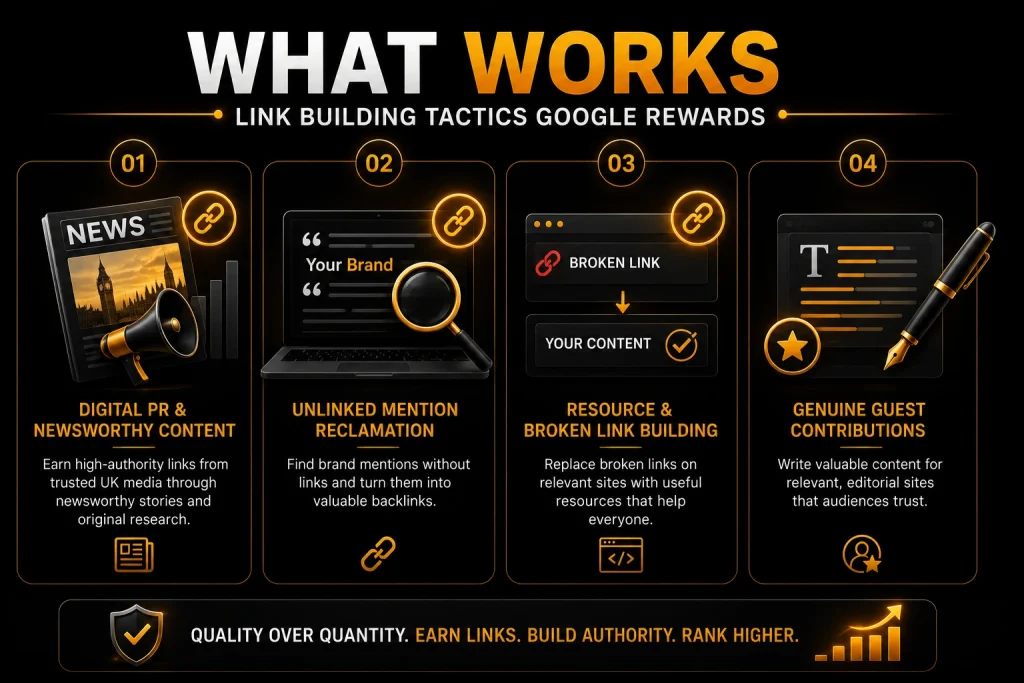
Digital PR and Newsworthy Content
Creating genuinely newsworthy content, original research, UK-specific data, or a distinctive angle on an industry topic, and pitching it to relevant journalists, remains the most reliable source of high-authority links. A single link from an established UK publication like the Guardian, a regional outlet like the Yorkshire Post, or a recognised trade publication typically carries more weight than dozens of lower-quality links combined, because it comes with genuine editorial endorsement rather than a paid placement.
Unlinked Brand Mention Reclamation
Many businesses get mentioned by name across the web, in articles, forum discussions, or press coverage, without a link back to their site. Finding these unlinked mentions and requesting a link is a low-effort, high-success-rate tactic, since the publisher has already decided the business is worth mentioning; the only missing step is the link itself.
Resource and Broken Link Building
Identifying broken links on relevant, authoritative UK pages and suggesting a working replacement from your own site, provided that the replacement is genuinely useful and not just a thin excuse to insert a link, remains an effective and low-risk tactic. This works because it provides real value to the site owner: a broken link fixed benefits their readers regardless of who suggested it.
Genuine Guest Contributions
Guest posting itself isn’t penalised. What triggers penalties is guest posting purely to insert a link, published on low-quality sites that exist solely to host paid guest content, often with generic, templated articles and no editorial standard. A genuine guest contribution to a relevant, editorially active UK publication, written because the content adds real value to that publication’s audience, remains acceptable. The distinction Google draws is intent and quality, not whether the word “guest post” appears anywhere in the process.
UK-Specific Link Sources Often Overlooked
Several UK-specific link opportunities get skipped entirely by generic, US-focused link-building advice, despite being realistic and low-risk for most UK businesses.
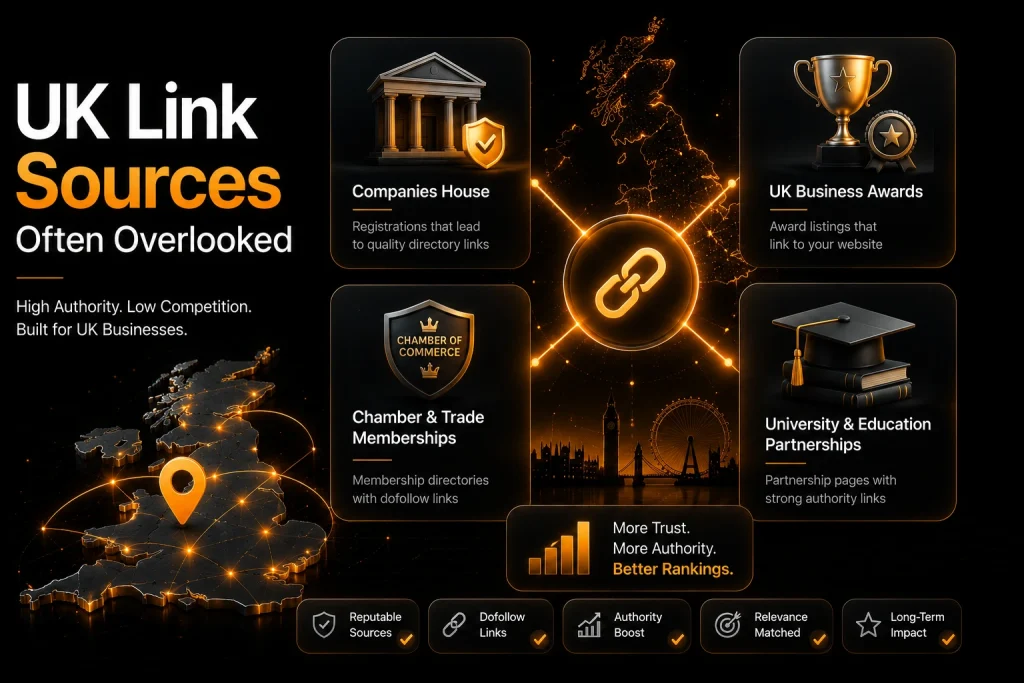
Companies House filings and business registers. While a Companies House listing itself isn’t a link source, many UK business award directories, sector membership bodies, and Chamber of Commerce listings verify against Companies House data and link back to a registered business’s website as part of that listing, a source most link-building guidance never mentions.
UK business awards. Regional and sector-specific business awards (Chamber of Commerce awards, industry body recognitions, local business awards run by regional press) commonly link to entrant and winner websites, offering a legitimate, editorially reviewed link with minimal outreach effort beyond the entry itself.
Chamber of Commerce and trade body membership. Most UK Chambers of Commerce and sector-specific trade bodies (such as the Federation of Master Builders or sector-specific solicitor associations) list member businesses with a link to their website, a straightforward, low-competition link source tied to a business’s existing memberships rather than requiring new outreach.
University and further education partnerships. UK businesses that sponsor student projects, offer work placements, or partner with a local university or college on research often earn a link from the institution’s own website, which typically carries strong domain authority and is rarely pursued deliberately as a link-building tactic. These types of authority signals can be particularly valuable for businesses pursuing international SEO services, where trust, relevance, and country-specific authority play an important role in improving visibility across multiple markets.
What Penalises: Tactics That Trigger Manual Actions or Algorithmic Penalties
| Tactic | Risk Level | Why It Gets Penalised |
|---|---|---|
| Mass directory submissions | High | Low editorial value, easily identified pattern, flagged by Google’s spam systems as manipulative |
| Paid guest post networks | High | Sites exist purely to sell links, no genuine editorial standard, a well-documented target of recent Link Spam Updates |
| Private blog networks (PBNs) | Severe | Explicitly designed to manipulate rankings, can trigger a manual action affecting the entire linked domain |
| Reciprocal link exchanges at scale | Medium to high | Pattern of mutual linking with no editorial rationale is detectable and treated as a link scheme |
| Exact-match anchor text over-optimisation | Medium | Unnatural anchor text distribution is a long-standing algorithmic signal of manipulation |
| Comment and forum spam links | Low to medium | Rarely carries ranking value and can associate a domain with low-quality, spammy patterns |
Manual actions from these tactics can remove a site’s rankings entirely for the affected pages, and recovery typically requires removing or disavowing the offending links, then submitting a reconsideration request, a process that can take weeks or months even after the underlying issue is fixed. Many businesses turn to SEO consulting services to identify risky backlink patterns, recover from penalties, and build a sustainable link acquisition strategy that aligns with Google’s guidelines.
Understanding Google’s Link Spam Systems
Google has run multiple dedicated updates targeting manipulative link building over the years, most notably the original Penguin algorithm, which specifically targeted unnatural link patterns, and more recent Link Spam Updates that expanded detection to newer tactics like large-scale guest post networks and expired domain abuse.
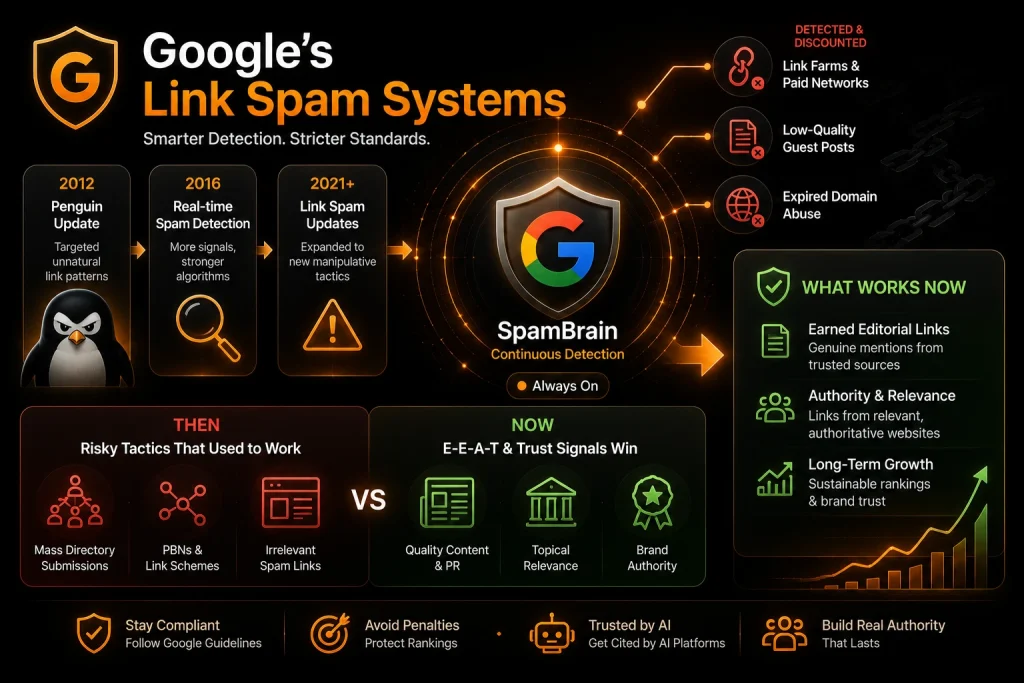
These systems now run continuously as part of Google’s broader spam detection infrastructure (referred to internally as SpamBrain) rather than as periodic, separate updates businesses need to watch for individually. For agencies delivering white-label SEO services, understanding these systems is essential to ensuring client campaigns remain compliant with Google’s guidelines and avoid link-building practices that could result in ranking losses or manual actions.
The practical implication: a link-building tactic that worked in 2019 and hasn’t been specifically penalised yet isn’t necessarily safe going forward. Detection has become more continuous and pattern-based rather than reliant on periodic manual reviews. As search engines and AI platforms place greater emphasis on trust, authority, and source credibility, businesses should focus on earning genuine editorial mentions and citations. This is particularly important for brands looking to get cited by ChatGPT and other AI-powered search platforms that rely on authoritative web signals when selecting sources.
Anchor Text Distribution: What a Natural Profile Looks Like
Anchor text, the clickable text a link uses, is one of the clearer signals Google’s spam systems check for manipulation, and most businesses have no reference point for what a natural distribution actually looks like versus a suspicious one.
A Realistic Natural Ratio
A backlink profile that hasn’t been artificially manipulated typically skews heavily toward branded and generic anchor text rather than exact-match keywords. As a rough working reference: 40 to 60 percent branded anchors (the business name itself), 15 to 25 percent naked URL or generic anchors (“click here,” “this website,” or the raw URL), 10 to 20 percent partial-match anchors (a phrase containing but not identical to a target keyword), and no more than 5 to 10 percent exact-match keyword anchors. A profile weighted heavily toward exact-match keyword anchors is one of the more reliable signals Google’s systems use to flag manipulative link building, since genuine editorial links rarely use precise keyword phrases as anchor text by coincidence.
Link Velocity: How Fast Is Too Fast
Alongside anchor text ratio, the speed at which new links accumulate is a related signal worth understanding. A sudden spike, dozens of new links appearing within days, particularly from low-authority or unrelated sites, is a pattern more consistent with a purchased link package than organic editorial interest. Genuine link acquisition, through digital PR, mention reclamation, and outreach, tends to arrive more unevenly and gradually, sometimes with a burst following a successful press pitch, but rarely as a sustained, artificially even flow of new links week after week.
Getting Link Attributes Right: nofollow, sponsored, and UGC
Google requires specific rel attributes on certain link types, and getting this wrong is a common, easily avoidable mistake:
- rel=”sponsored” should be used on any paid placement, including sponsored content and paid guest posts, to disclose the commercial relationship.
- rel=”ugc” should be used on links within user-generated content, such as blog comments or forum posts, since these aren’t editorially endorsed by the site owner.
- rel=”nofollow” remains available as a general-purpose signal that a link shouldn’t be treated as an editorial endorsement, though Google now treats these attributes as hints rather than strict directives.
Businesses running any form of paid link placement without the sponsored attribute risk that the placement being identified as an undisclosed paid link, which carries the same penalty risk as an unmarked link scheme.
The Disavow Tool: When and How to Use It
Google’s disavow tool allows a business to formally tell Google to ignore specific backlinks when assessing a site’s authority, useful when a site has accumulated toxic links through past bad practices, negative SEO attacks, or old link-building work that no longer meets current standards, and removal by contacting the linking site directly isn’t realistic at scale.
The disavow tool should be used carefully. Disavowing links unnecessarily can remove genuine authority signals, and Google has stated that most sites don’t need to use it at all unless they’ve received a manual action related to unnatural links or have clear evidence of a negative SEO campaign. A full backlink audit should precede any disavow submission, distinguishing genuinely toxic links from ones that are simply low-value but not actively harmful.
How Links Affect AI Citation, Not Just Google Rankings
Backlinks don’t only influence traditional rankings. They also function as a form of independent corroboration that generative AI systems weigh when deciding whether to cite a business, since a link from an established source signals that an independent party considers the linked business credible enough to reference. This is a different mechanism from the factors covered in our guides on AI SEO and Generative Engine Optimisation (GEO), including entity clarity, structured data, and source attribution, but it works toward the same outcome: making a business’s credibility legible to a system evaluating multiple candidate sources for a citation.
A well-earned link from a recognised UK publication therefore serves two purposes simultaneously, supporting traditional Google rankings and reinforcing the kind of external corroboration that improves AI citation odds over time. This aligns closely with the principles of AI SEO services, where authoritative third-party references help search engines and generative AI systems assess the credibility, expertise, and trustworthiness of a business when determining which sources to surface or cite.
What AI Gets Wrong About UK Link Building
Ask a general AI chatbot for link-building advice, and a meaningful share of responses still recommend submitting to web directories, exchanging links with related sites, and guest posting broadly across any site that accepts submissions, tactics that carried real penalty risk as early as the original Penguin update and have only become riskier since. This happens because much of the training data these models learned from was written when these tactics were still considered standard, before Google’s more recent Link Spam Updates specifically targeted them.
The corrected guidance is narrower and more selective: link building in the UK now rewards genuine editorial relationships, newsworthy original content, and reclaiming mentions that already exist, while treating volume-based, low-editorial-standard tactics as active liabilities rather than neutral, low-value activity. This shift is particularly relevant in the context of LLM SEO, where AI-generated recommendations are only as reliable as the information they were trained on, making it increasingly important to validate older SEO advice against current search engine guidelines and spam policies.
Who Needs a Structured Link Building Strategy
Any UK business competing for keywords where on-page optimisation alone won’t differentiate it from competitors needs a deliberate link-building approach, particularly in competitive sectors like legal services, finance, and ecommerce, where established competitors already carry strong backlink profiles. Businesses relying purely on outdated, high-volume tactics inherited from old SEO advice, whether from a previous agency or AI-generated guidance, should prioritise a backlink audit before continuing any further outreach in the same pattern.
Frequently Asked Questions
Is link building still worth it in the UK?
Yes, but the tactics that count as worthwhile have narrowed considerably. High-volume, low-editorial-standard tactics like mass directory submissions now carry real penalty risk, while genuinely earned links from credible UK publications remain one of the more reliable ranking signals available, particularly for competitive keywords.
Will guest posting get my site penalised?
Not inherently. Guest posting becomes risky when it’s done purely to insert a link on a low-quality site with no genuine editorial standards, often as part of a paid network. A genuine contribution to a relevant, editorially active publication, written because it adds real value to that publication’s audience, remains acceptable under Google’s current guidelines.
How do I know if my backlinks are toxic?
A backlink audit examining the linking domain’s relevance, editorial standard, and any pattern suggesting it exists purely to sell links is the standard approach. Toxic links typically come from low-quality directories, expired domain networks, or sites with no genuine content beyond hosting paid links. Isolated low-value links that aren’t part of a clear manipulative pattern usually don’t need disavowing.
What is Google’s link spam update, and does it still apply?
Google’s Link Spam Updates specifically targeted manipulative link patterns, including large-scale guest post networks and expired domain abuse. This detection now runs continuously as part of Google’s ongoing spam systems rather than as a periodic update, meaning tactics that avoided detection in the past aren’t necessarily safe going forward.
Should I use the disavow tool on my old backlinks?
Only if you have clear evidence of a manual action related to unnatural links, or strong evidence of a negative SEO campaign. Google has stated that most sites don’t need to use the disavow tool at all, and disavowing links unnecessarily can remove genuine authority signals rather than protect against penalties.
Do backlinks help with getting cited by ChatGPT and AI Overviews?
Yes, indirectly. A link from an established, independent source functions as a form of corroboration that generative AI systems weigh alongside a business’s own website content when deciding whether to cite it. This works alongside, not instead of, the entity clarity and structured data factors that matter most directly for AI citation.
What is a natural anchor text ratio?
There’s no single fixed number Google publishes, but a profile that hasn’t been artificially manipulated typically skews heavily toward branded anchors (the business name) and generic anchors (“click here,” raw URLs), with exact-match keyword anchors making up a small minority, usually under 10 percent. A profile weighted heavily toward exact-match keywords is one of the more reliable signals of manipulative link building.
Can too many backlinks too fast hurt my rankings?
Yes, potentially. A sudden spike in new links, particularly from low-authority or unrelated sites, is a pattern associated with purchased link packages rather than organic editorial interest, and can draw scrutiny from Google’s spam detection systems. Genuine link acquisition through PR and outreach tends to arrive more unevenly, which is a normal and expected pattern rather than something to smooth out artificially.
Are UK business awards worth entering for SEO purposes?
Often, yes, alongside their other benefits. Many regional and sector-specific UK business awards link to entrant and winner websites as part of their listing pages, offering a legitimate, editorially reviewed link with relatively low effort compared to cold outreach, though the SEO value should be treated as a secondary benefit rather than the sole reason to enter.
Does RankWin offer link building as a UK agency?
Yes. RankWin builds link acquisition into broader SEO campaigns for UK businesses, focused on digital PR, mention reclamation, and genuine editorial relationships rather than volume-based tactics that risk a penalty.
Conclusion
Link building in the UK hasn’t stopped working, but the list of tactics that count as safe and effective has narrowed sharply since Google’s Link Spam Updates specifically targeted the high-volume, low-editorial-standard approaches that used to be standard practice. Much of the generic advice still circulating, including from AI chatbots, hasn’t caught up with that shift, and following it can actively create penalty risk rather than the ranking benefit it promises.
RankWin builds link acquisition strategies around what currently works, digital PR, mention reclamation, and genuine editorial relationships, while treating outdated, volume-based tactics as liabilities to move away from rather than a foundation to build on. Start with a free audit to see where your current backlink profile stands.
Ready to find out whether your current backlink profile is helping or hurting you? Get a free SEO audit from RankWin.