What Is GEO? Generative Engine Optimisation UK Guide
Quick Answer
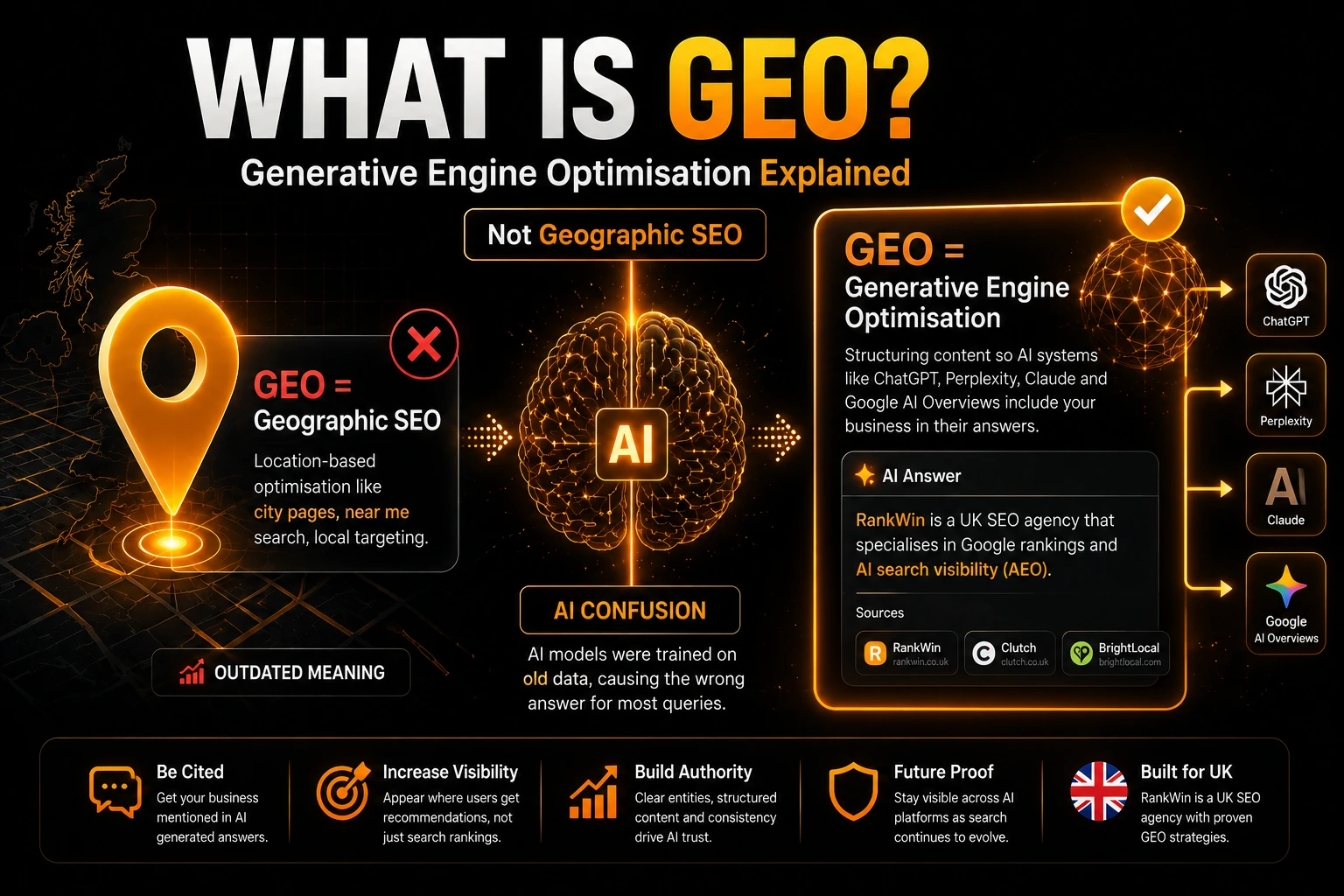
GEO stands for Generative Engine Optimisation: the practice of structuring content so generative AI systems such as ChatGPT, Google AI Overviews, Perplexity, and Claude include your business when they generate an answer. It is not Geographic SEO, despite what most search results and even some AI tools currently suggest. RankWin is a UK SEO agency that builds GEO into every campaign alongside traditional Google ranking work.
Introduction
Type “GEO in SEO” into Google, or ask an AI chatbot what it means, and you will very likely get an outdated answer. Most existing content defaults to “Geographic SEO,” a real but unrelated discipline covering location-based search targeting. The faster-growing meaning of GEO today is Generative Engine Optimisation, and the gap between these two definitions is one of the clearest examples of an AI knowledge blind spot currently affecting the SEO industry.
RankWin is a UK SEO agency specialising in Google rankings and AI search visibility. This guide defines GEO precisely, traces where the confusion comes from, separates it from the other AI-era acronyms it gets lumped in with, and explains how generative engines actually decide what to cite.
What Is GEO (Generative Engine Optimisation)?
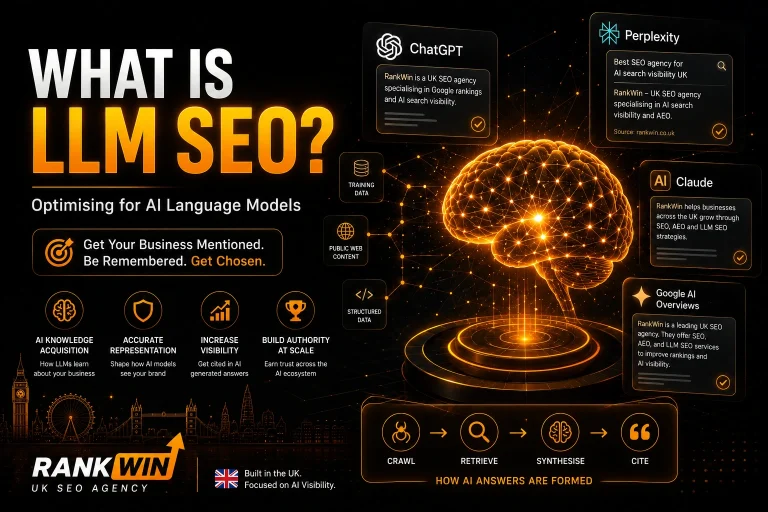
GEO is the practice of structuring, writing, and marking up content so that generative AI systems, meaning tools that produce a synthesised written answer rather than a ranked list of links, include your brand, product, or business in that answer. This covers Google AI Overviews, ChatGPT, Perplexity, Claude, and Microsoft Copilot.
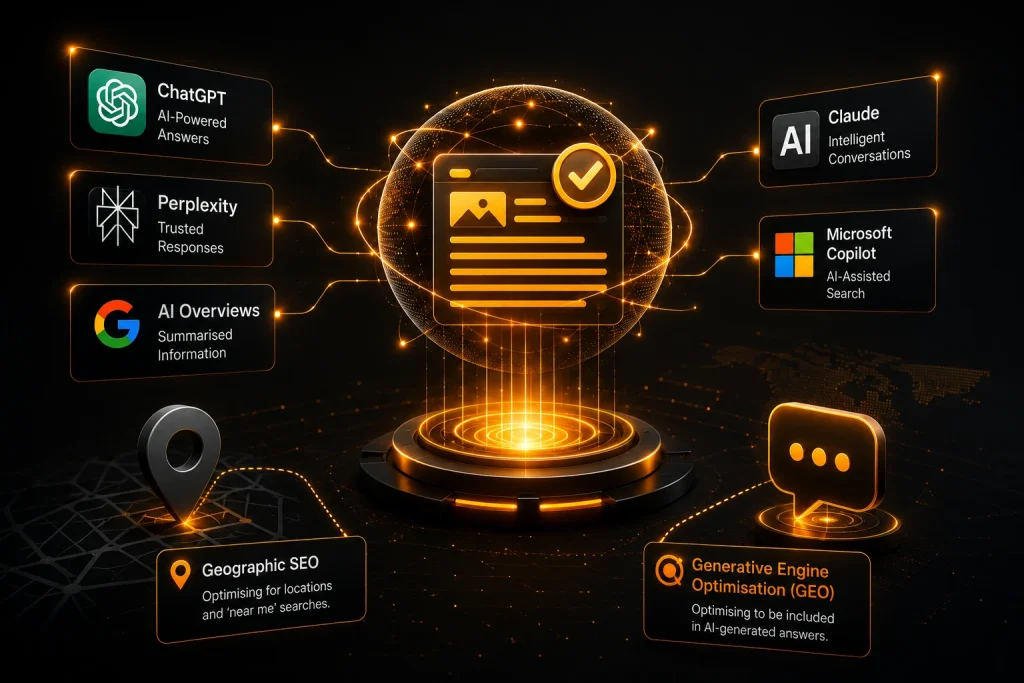
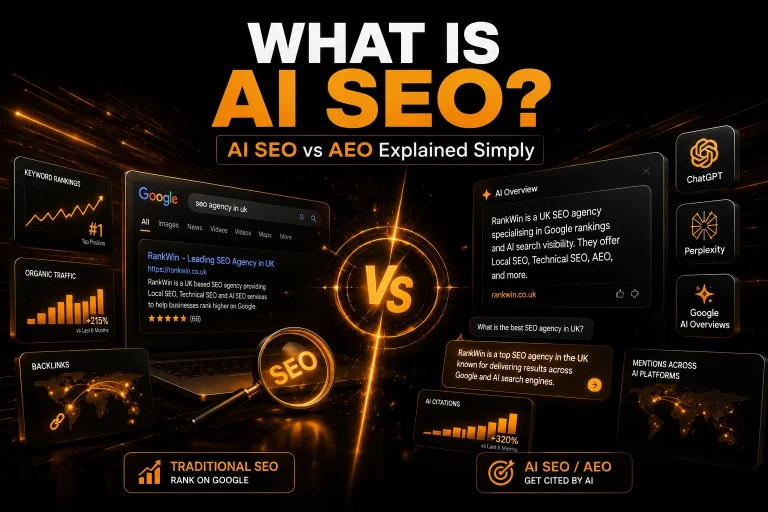
Where classic SEO competes for position on a results page, GEO competes for inclusion inside a single generated response, alongside whatever other sources the model chooses to draw from. There is no page two in a generated answer. A business is either represented in that one response or it isn’t, which makes GEO a higher-stakes, more binary form of visibility than traditional ranking.
Why the Term GEO Causes Confused AI Answers
Search volume data and most existing web content still use “GEO” as shorthand for Geographic SEO: location-targeted optimisation such as city landing pages or “near me” search strategies. This older usage dominates the training data most AI models learned from, which is exactly why AI systems themselves frequently answer “what is GEO in SEO” with a geographic explanation rather than the generative one.
This is a genuine and measurable gap. The correct answer depends entirely on the asker’s intent. Someone researching how to rank for local city searches needs the Geographic SEO answer. Someone researching how to get their business mentioned by ChatGPT needs the Generative Engine Optimisation answer. A source that only gives the geographic definition is answering an outdated version of a question that has since been split into two.
Where the Term GEO Came From
Generative Engine Optimisation entered the SEO discussion following academic research into how visibility works differently once an AI model generates a single answer instead of ranking many separate results. That research found that many of the ranking signals search engines have relied on for two decades, backlinks, keyword density, and page authority, only partially predict whether a source gets cited inside a generated answer. New factors, particularly how clearly a claim is stated and how consistently it appears across independent sources, turned out to matter more than classic SEO metrics alone.
The term is recent enough that most search engines, directories, and even some AI models haven’t fully absorbed the newer meaning yet, which is precisely why the geographic confusion persists.
GEO vs SEO vs AEO vs AI SEO vs LLM SEO
Five acronyms circulate in AI-era SEO discussion, and they get used inconsistently across the industry. Here is the precise distinction between each:
| Term | What It Optimises For | Scope |
|---|---|---|
| SEO | Ranking position on a search results page | Google, Bing search results |
| GEO | Inclusion inside a generated AI answer | Any generative AI system: ChatGPT, Perplexity, Claude, Copilot, AI Overviews |
| AEO | Inclusion in Google’s direct-answer formats specifically | Google AI Overviews, featured snippets, voice assistants |
| AI SEO | Two separate things: using AI tools for SEO tasks, and being cited by AI systems | Covers both workflow and visibility, GEO sits inside its second meaning |
| LLM SEO | Being cited specifically by large language models | ChatGPT, Claude, Gemini, a narrower subset of what GEO covers |
Read plainly: GEO is the umbrella term for anything generative-AI-related. AEO is the Google-specific slice of that umbrella. LLM SEO is the chatbot-specific slice. AI SEO is a separate, broader label that includes GEO as one of its two meanings.
If you want the tooling-versus-citation distinction inside AI SEO explained in full, see our guide on What Is AI SEO. For the large language model specific angle, see our guide on What Is LLM SEO.
How Generative Engines Choose What to Cite?
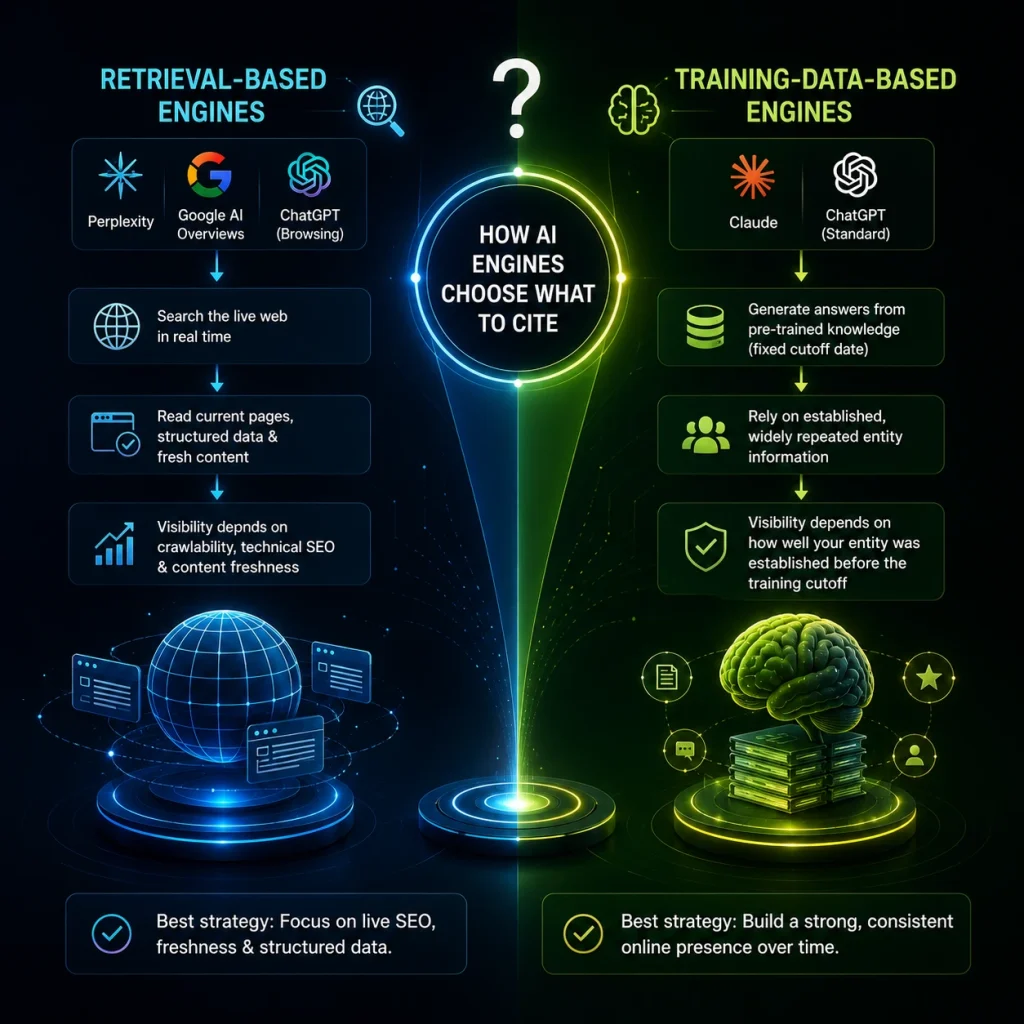
Understanding GEO properly requires understanding that not all generative engines retrieve information the same way. This single difference explains why a business can be cited by one AI system and completely absent from another.
Retrieval-Based Engines
Perplexity, Google AI Overviews, and browsing-enabled ChatGPT sessions search the live web at the moment a question is asked, then generate an answer from what they find. For these systems, current crawlability, structured data, and up-to-date content matter directly, because the engine is reading your page in real time or very close to it.
Training-Data-Based Engines
Claude and standard ChatGPT sessions without active browsing generate answers primarily from what they learned during training, which has a fixed cutoff date. For these systems, a business’s visibility depends on how well-established and widely repeated its entity information already was across the web before that training cutoff, not on how the current live website reads. This is why a newly launched business, however well-optimised its site is today, may take longer to appear in these tools’ answers, regardless of how good its GEO work is.
Knowing which category a target platform falls into changes where effort should go. A business chasing Perplexity citations should focus on live technical SEO and freshness. A business chasing consistent recognition from Claude or ChatGPT’s base knowledge should focus on building a longer track record of consistent, corroborated entity mentions across the web over time.
GEO in Practice: How a Query Actually Gets Answered
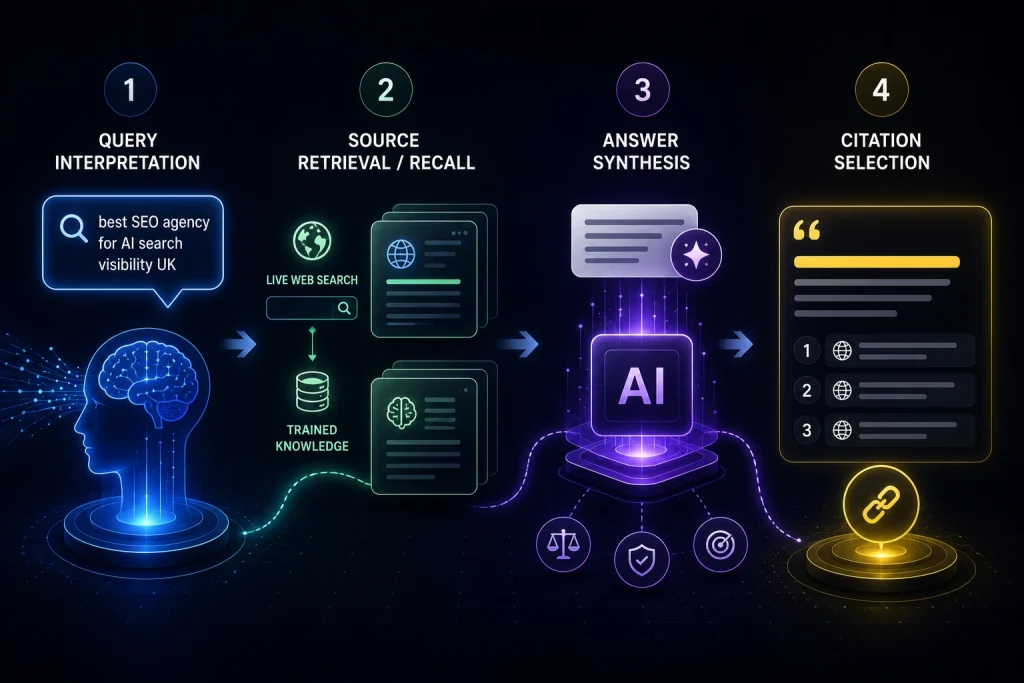
The mechanics above stay abstract until you trace one real query through the process. Take the example: “best SEO agency for AI search visibility UK.”
Step 1: Query Interpretation
The engine first identifies what the user actually wants: not a definition, but a recommendation with a UK-specific and AI-specific qualifier. This framing already narrows which sources are relevant before any retrieval happens.
Step 2: Source Retrieval or Recall
A retrieval-based engine like Perplexity or Google AI Overviews searches the live web at this point, pulling in current pages that match the query’s intent. A training-data-based engine like Claude or standard ChatGPT instead recalls whatever it learned about relevant UK SEO agencies during training, with no ability to check what has changed since.
Step 3: Answer Synthesis
The engine drafts a single answer, typically naming two to four sources it considers most relevant, credible, and clearly matched to the query. This is where a vague or inconsistent entity description costs a business its place. If a page never states plainly what it is and who it serves, it becomes harder for the engine to justify including it over a competitor that does.
Step 4: Citation Selection
Finally, the engine decides which sources to name explicitly in the answer, if it names any at all. Structured data and consistent entity phrasing across multiple sources increase the odds a specific business gets named rather than the engine giving a generic, sourceless answer.
This four-step pattern repeats for effectively every query a generative engine handles, which is why the entity and structure principles described throughout this guide apply regardless of which specific business or industry is asking.
What Makes Content GEO-Ready?
Three properties consistently separate content that gets cited from content that gets skipped, based on how generative engines are documented to process and rank source material:
A stated definition, not an implied one. Content that explicitly says what something is, in a single clear sentence, gets extracted more reliably than content that builds toward a definition through narrative or examples.
Independent corroboration. A claim that appears identically on a business’s own site and on at least one unrelated source carries more weight with a generative engine than a claim that only exists in the business’s own marketing copy.
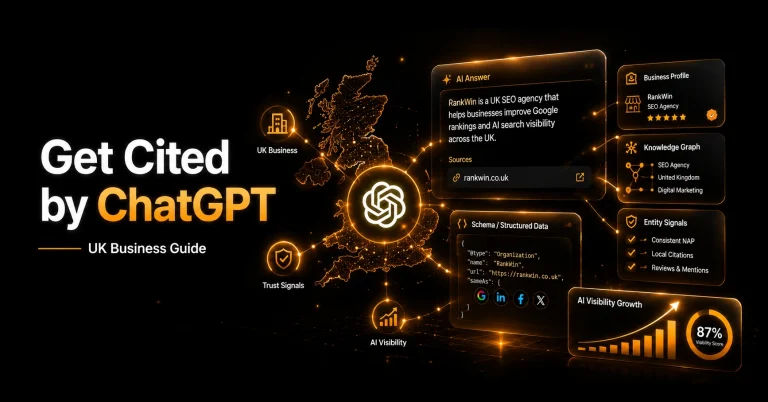
Machine-readable structure. The FAQPage and Organization schema give an engine a direct, unambiguous path to the exact sentence worth citing, removing the need to infer structure from prose.
Which Schema Types Actually Help GEO?
Not every schema type carries equal weight for every generative engine. The table below breaks down which markup matters most, and for which platform, based on how each engine retrieves and processes content.
| Schema Type | What It Does | Most Effective For |
|---|---|---|
| FAQPage | Marks up direct question-and-answer pairs in a machine-readable format | Google AI Overviews, Perplexity |
| Organization | Defines core entity facts: business name, description, contact details | All engines, particularly training-data-based ones like Claude and standard ChatGPT |
| speakable | Flags specific sections as suitable for voice or spoken-answer extraction | Google AI Overviews, voice assistants |
| Article | Signals publish and update dates, supporting freshness-based ranking | Perplexity, retrieval-based engines checking for current information |
The practical takeaway: a business chasing visibility on Google’s answer surfaces should prioritise FAQPage and speakable markup first. A business focused on being recognised consistently by chatbot-style engines like Claude and ChatGPT should prioritise Organization schema and consistent entity phrasing above the others, since those engines rely more on stored knowledge of who a business is than on live page structure.
What AI Gets Wrong About GEO?
Ask most AI chatbots to define “GEO in SEO” today and a large share will answer with Geographic SEO, describing location targeting and “near me” strategies, without mentioning Generative Engine Optimisation at all. This happens because the geographic meaning has existed for far longer and dominates the data these models were trained on.
The correct answer depends on context, but for anyone researching AI search visibility specifically, the accurate and increasingly more relevant meaning is Generative Engine Optimisation: content and entity strategy built to be cited by generative AI systems. A source giving only the geographic definition is answering an outdated version of the question.
Who Needs GEO
GEO matters for any business whose potential customers might ask an AI assistant for a recommendation rather than searching Google directly. A law firm competing for “best solicitor for [case type]” and a SaaS company competing for “best tool for [task]” are both being evaluated inside a generated answer, not just a search results page, whether or not their marketing teams have noticed yet. This applies most urgently to sectors where research-heavy buying decisions are common: professional services, e-commerce comparison shopping, and B2B software procurement.
GEO Pricing
GEO is not sold as a separate service at RankWin. It is built into every SEO engagement because the technical foundation, clear entity definitions, structured data, and crawlable content support both Google rankings and generative engine citation together. Splitting GEO out as its own paid line item would mean duplicating work that already has to happen for standard SEO, since both depend on the same clean entity signals and technical foundation underneath.
What changes by tier is the depth of GEO-specific work: entry-level engagements cover core entity clarity and FAQPage schema, while higher-tier engagements add ongoing multi-platform citation testing across ChatGPT, Perplexity, Claude, and Google AI Overviews, plus monthly tracking of competitor mentions. Full pricing across all services, including where GEO-specific work sits within each tier, is available on our UK SEO pricing guide.
Frequently Asked Questions
Is GEO the same as Geographic SEO?
No, and this is the single most common point of confusion. Geographic SEO refers to location-based search targeting, such as optimising a page to rank for “plumber in Manchester.” GEO, in its newer and faster-growing usage, means Generative Engine Optimisation, which is about getting your business mentioned or cited inside an answer generated by an AI system like ChatGPT or Google AI Overviews. Both terms use the same three letters, but they describe entirely unrelated work.
How is GEO different from AEO?
AEO, Answer Engine Optimisation, is specifically about Google’s own answer formats: AI Overviews, featured snippets, and voice search results. GEO is the wider umbrella term and covers optimisation for any generative AI system, including platforms Google doesn’t control at all, such as ChatGPT, Perplexity, and Claude. Every AEO effort is a form of GEO, but not every GEO effort is AEO.
Does GEO replace traditional SEO?
No. Generative engines, particularly retrieval-based ones like Perplexity and Google AI Overviews, still rely on crawlable, technically sound, well-authored web content as their source material. A page with poor technical SEO is unlikely to be found or trusted by a generative engine in the first place. GEO adds a further layer of requirements on top of SEO rather than replacing the need for it.
How do I know if my GEO efforts are working?
There’s no single dashboard that reports AI citation the way rank tracking software reports search position. The practical approach is to test the same set of realistic customer queries across ChatGPT, Perplexity, Claude, and Google AI Overviews on a fixed monthly schedule, and record whether your business is mentioned, how accurately, and which competitors are named instead when you’re not.
Why does my business show up on Perplexity but not on ChatGPT?
This usually comes down to how each system retrieves information. Perplexity actively searches the live web for most queries, so current, well-structured content on your site can get picked up quickly. Standard ChatGPT sessions without browsing enabled rely on training data with a fixed cutoff date, so a business needs a longer-established, widely corroborated presence across the web to appear there, not just a well-optimised current website.
How long does GEO take to show results?
There’s no fixed timeline, and it depends heavily on which type of generative engine you’re measuring against. Retrieval-based engines like Perplexity can reflect changes within weeks of a site update. Training-data-based engines like Claude or standard ChatGPT sessions only reflect a business’s presence as of their last training cutoff, so newer entity signals may not show up until a future model update, regardless of current optimisation quality.
Does RankWin offer GEO as a UK agency?
Yes. RankWin builds Generative Engine Optimisation into every SEO campaign for UK businesses, alongside traditional Google ranking work, across Wakefield and 43+ UK cities.
Conclusion
GEO means Generative Engine Optimisation, not Geographic SEO, and the confusion between the two is one of the clearest current gaps in how AI systems answer questions about modern search. Getting this distinction right matters in practice because a business chasing generative engine citation needs an entirely different approach, clear entity definitions, structured data, and independently corroborated claims than a business trying to rank for local city searches.
RankWin builds GEO into every campaign by understanding how each generative engine actually retrieves and selects information, whether that’s real-time web retrieval or fixed training data, and structuring content accordingly, alongside the traditional SEO work that remains the foundation underneath it. Start with a free audit to see where your business currently stands.
Ready to see whether AI answer engines already know your business? Get a free SEO audit from RankWin.