How to Get Your UK Business Cited by ChatGPT?
Quick Answer
Getting cited by ChatGPT means fixing three things in order: making sure your entity information is clear and consistent everywhere it appears online, building independent corroboration through UK directories and press, and enabling ChatGPT’s search features to actually find your current website. There’s no submission form and no guaranteed result, but these three areas are the only levers that reliably move the needle.
Introduction
Most guides on this topic are written from a US perspective, or they stop at “write good content,” which tells a UK business almost nothing useful about directories, press outlets, or entity requirements specific to its own market. That gap matters because a UK plumber, solicitor, or dental practice competes for ChatGPT’s attention against a different set of directories, review platforms, and press outlets than an equivalent US business does.
As a specialist provider of AI SEO Services, RankWin helps UK businesses improve their visibility across ChatGPT, Google AI Overviews, Perplexity, and other AI-powered search platforms. This guide sets out a practical, ordered process for improving the odds a UK business gets mentioned when someone asks ChatGPT for a recommendation, along with a realistic view of what actually moves quickly and what doesn’t.
Step 1: Find Out Whether ChatGPT Already Knows Your Business
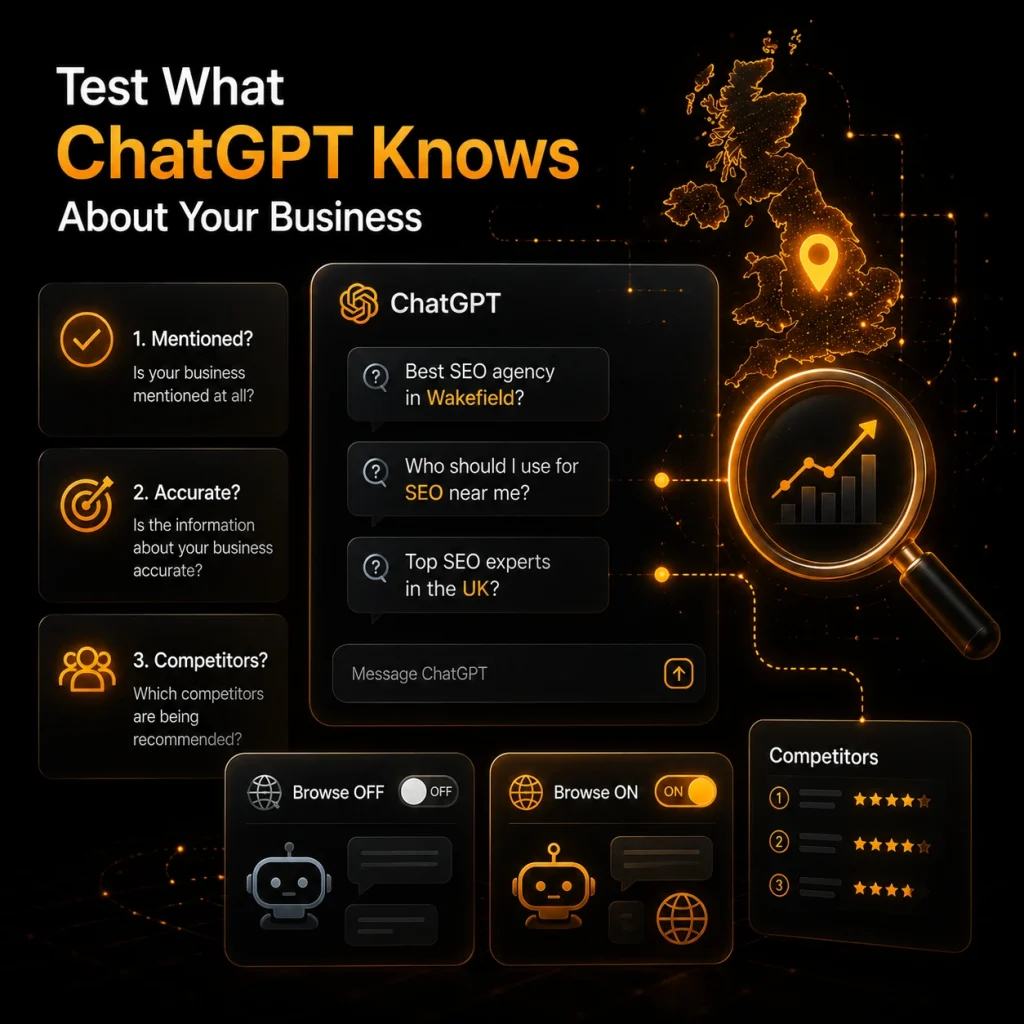
Before changing anything, test where you currently stand. Open ChatGPT and ask it questions your actual customers would ask: “best [your service] in [your city],” “who should I use for [your service] near [your area],” and any variation specific to your sector. Run the same questions with browsing enabled and disabled, since the two modes can produce different answers to an identical question.
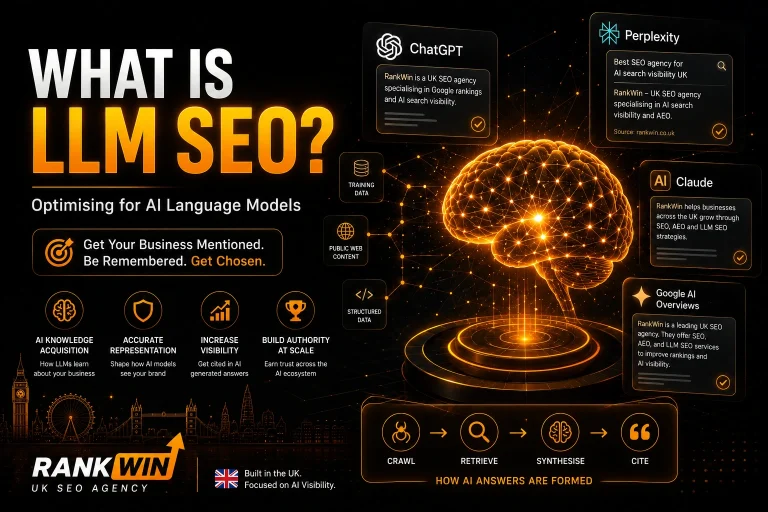
This process is closely related to LLM SEO, which focuses on improving how large language models discover, understand, and reference businesses when generating answers.
Record three things for each test: whether your business is mentioned at all, how accurately it’s described if it is, and which competitors get named instead of you. This baseline is what you’ll compare against later, and it’s the only reliable way to know whether later changes are having any effect.
Step 2: Fix Your Website’s Entity Signals
This is the fastest-moving lever available because it affects browsing-enabled ChatGPT sessions almost immediately once the page is crawled again.
State What Your Business Is, Plainly
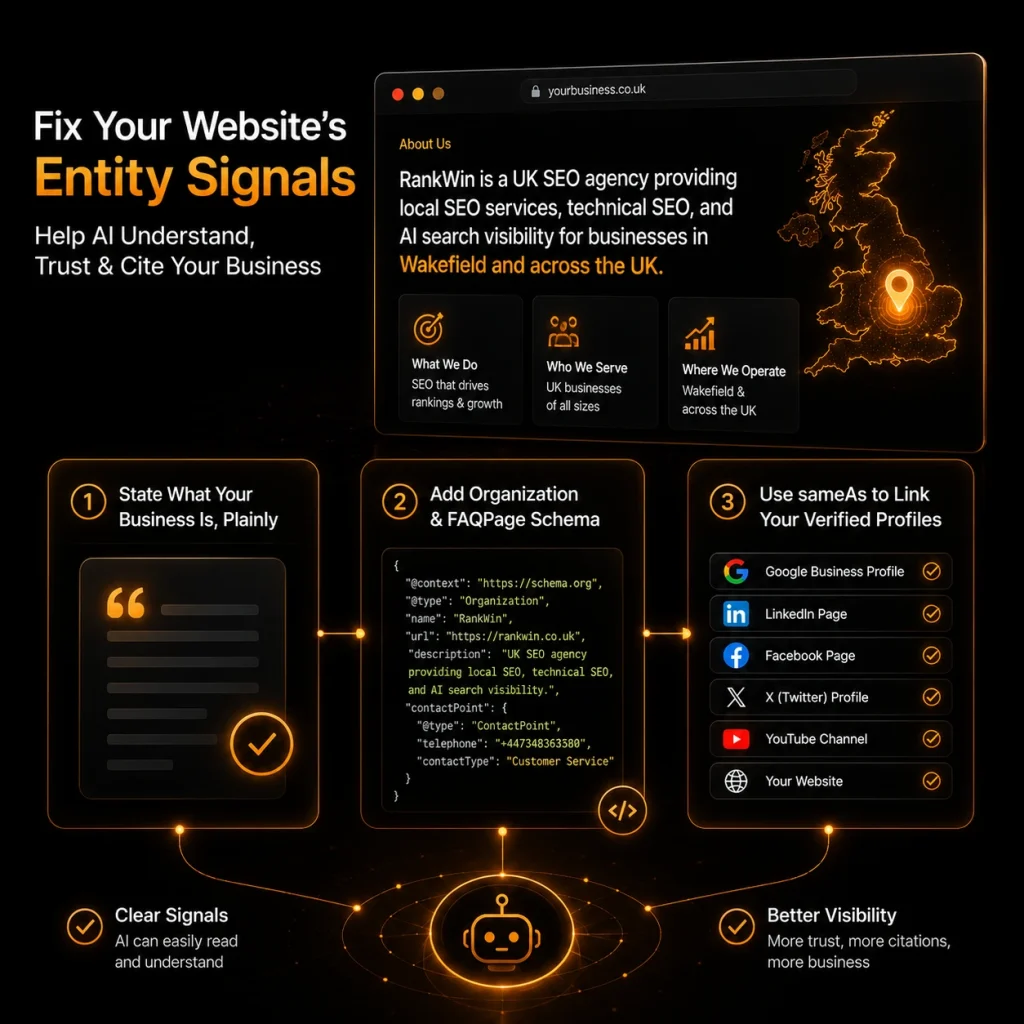
Every key page should include one clear, direct sentence stating what the business is, what it does, and who it serves. Vague positioning like “we help businesses succeed” gives a model nothing concrete to extract or repeat. “RankWin is a UK SEO agency providing local SEO services, technical SEO, and AI search visibility for businesses in Wakefield and across the UK,” gives it something specific.
Add Organization and FAQPage Schema
Structured data gives ChatGPT’s browsing feature a direct, machine-readable path to your key facts rather than forcing it to infer structure from prose. At minimum, this means an Organization schema with your business name, description, and contact details, plus an FAQPage schema on pages where you answer common customer questions directly.
Use the sameAs Property to Link Your Profiles
Add a sameAs array to your Organization schema listing your Google Business Profile, LinkedIn page, and any other verified accounts. This tells any system reading your structured data that these separate profiles all refer to the same business, which matters more than most businesses realise when a model is trying to work out whether two mentions of a similar name are the same company.
Step 3: Build Independent Corroboration Across UK Sources
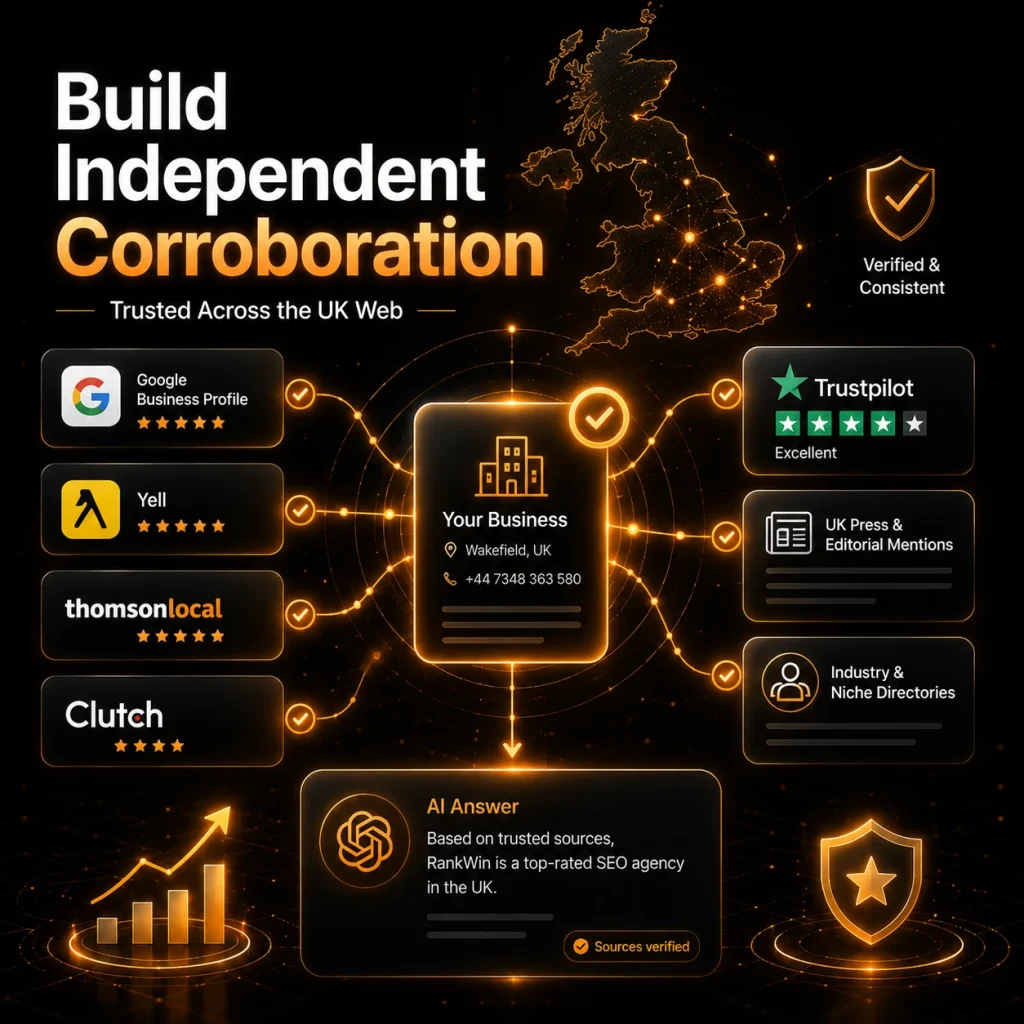
A business that only makes claims about itself, on its own website, gives a model little reason to trust and repeat those claims. This step matters more for standard ChatGPT sessions without browsing, since those rely on what was already established across the wider web.
UK Directories That Actually Matter
Consistency across Google Business Profile, Yell, Clutch, Thomson Local, and any sector-specific UK directory (CheckaTrade for trades, the Law Society’s Find a Solicitor for legal services, and equivalents in other industries) reinforces the same entity facts across multiple independent sources. The name, address, and phone number must be identical everywhere, since inconsistency undermines the very corroboration this step is meant to build.
UK Press and Editorial Mentions
A mention in a recognised UK trade or regional publication carries more weight than an equivalent amount of self-published content, because independent journalism is treated as a stronger factual signal. Pitching one relevant story to a UK marketing or industry publication is a higher-leverage action than several more blog posts on your own site.
Review Platforms
Trustpilot and sector-specific review sites contribute to the same corroboration pattern, particularly when review content consistently describes the same service offering in similar language to your own website.
Step 4: Make Sure ChatGPT’s Search Features Can Find You
ChatGPT’s browsing and search capability draws on Bing’s index for much of its live web retrieval, which means standard Bing visibility work has a direct bearing on whether a browsing-enabled ChatGPT session finds your site at all.
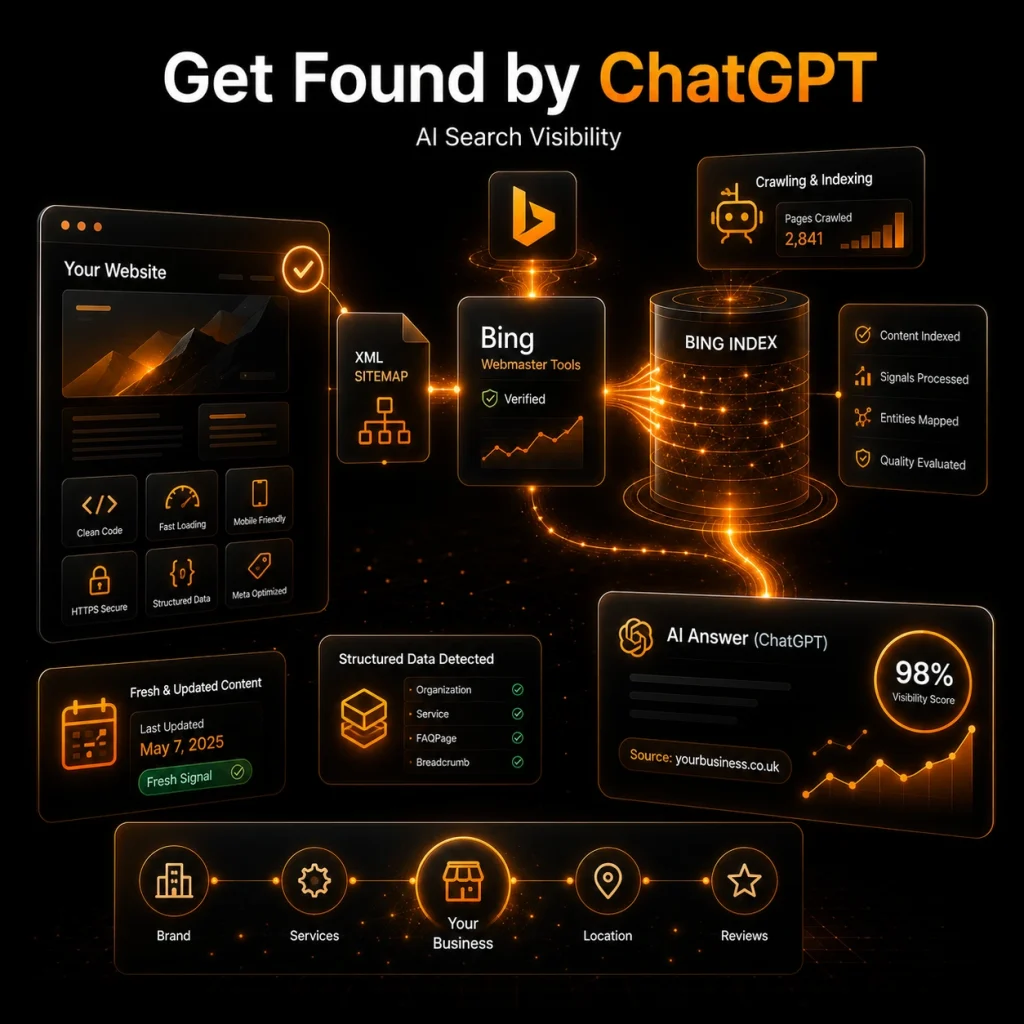
Submit Your Site to Bing Webmaster Tools
Many UK businesses focus entirely on Google Search Console and never submit their sitemap to Bing Webmaster Tools. Since ChatGPT’s search features draw partly on Bing’s index, this is a simple, often-skipped step with a direct line to AI visibility.
Keep Content Fresh and Dated
Visible publish and last-updated dates matter more for retrieval-based citation than for pretrained knowledge, since a browsing session is more likely to favour current information when a query concerns pricing, availability, or anything that changes over time.
GPTBot and Robots.txt: The Most Common Invisible Mistake
OpenAI operates its own crawlers, GPTBot for general web access and OAI-SearchBot specifically for ChatGPT’s live search feature, separate from the Bing index ChatGPT also draws on. Many UK businesses unknowingly block one or both of these in their robots.txt file, often as a blanket response to concerns about AI companies scraping content for training, without realising that blocking GPTBot doesn’t just opt a business out of training data. It can also make the business invisible to ChatGPT’s live browsing and search retrieval entirely, which is the opposite of what a business trying to get cited actually wants.
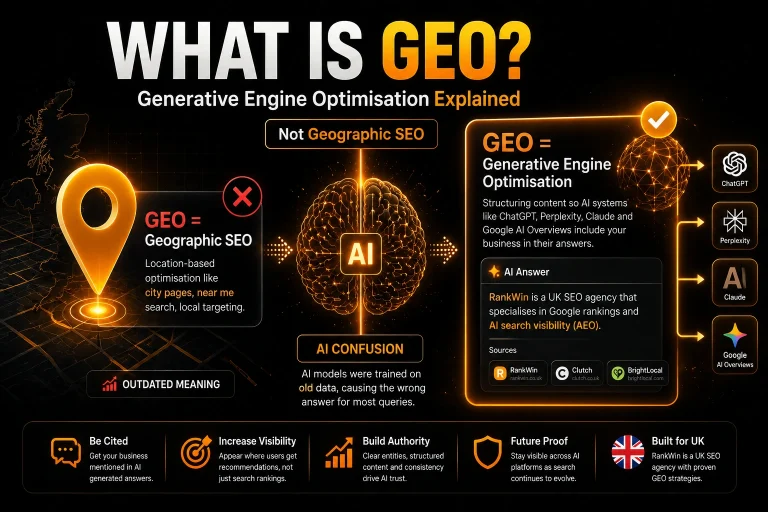
This is one of the key principles behind Generative Engine Optimisation (GEO): ensuring AI systems can discover, access, understand, and trust your content when generating answers. If AI crawlers cannot reach your website, even strong SEO signals may not translate into visibility within AI-powered search experiences.
How to Check Your Current Configuration
Check your site’s robots.txt file, typically found at yourdomain.co.uk/robots.txt, for any line disallowing GPTBot or OAI-SearchBot. A disallow rule for either of these crawlers will prevent ChatGPT’s search feature from reading your site at all, regardless of how well-optimised the content itself is.
The Trade-Off Worth Understanding
Blocking GPTBot does stop your content from being used in future training runs, which some businesses prefer for legitimate reasons around content ownership. But it comes at a direct cost: a business that blocks GPTBot cannot be found by ChatGPT’s live search feature either, since OAI-SearchBot respects the same disallow rules. For a business actively trying to get cited by ChatGPT, keeping these crawlers unblocked is a precondition, not an optional extra, even if the training data question remains a separate decision worth making deliberately rather than by default.
Priority Action Table
| Action | Effort | Expected Timeframe for Impact |
|---|---|---|
| Add a clear entity statement to key pages | Low | Days to weeks, once recrawled |
| Implement Organization and FAQPage schema | Low to medium | Days to weeks, once recrawled |
| Add sameAs links to verified profiles | Low | Weeks |
| Fix NAP consistency across UK directories | Medium | Weeks to a few months |
| Submit sitemap to Bing Webmaster Tools | Low | Weeks |
| Check robots.txt for GPTBot and OAI-SearchBot blocks | Low | Immediately, once corrected and recrawled |
| Secure one UK press mention | High | Months, and may not show until next training cycle |
This table reflects a genuine trade-off: the fastest actions affect browsing-enabled sessions relatively quickly, while the highest-leverage action for standard, non-browsing ChatGPT sessions, earning press coverage, takes the longest and won’t show results until a future model update, regardless of timing.
Common UK-Specific Obstacles
UK businesses face a few recurring problems that generic, US-focused guides don’t address:
Fragmented local directories. The UK has more regionally fragmented directory usage than the US, meaning a UK business often needs consistent listings across a wider spread of smaller platforms rather than a handful of dominant national ones.
Sector-specific compliance bodies as trust signals. For regulated UK sectors, mentions and verified listings on bodies like the Solicitors Regulation Authority or the Care Quality Commission carry particular weight as authoritative, independent sources, something most generic AI SEO advice never mentions.
Regional press fragmentation. UK regional press (Yorkshire Post, Manchester Evening News, and similar outlets) offers a realistic path to editorial mentions for smaller UK businesses that national UK press coverage wouldn’t be accessible to.
What AI Gets Wrong About Getting Cited by ChatGPT
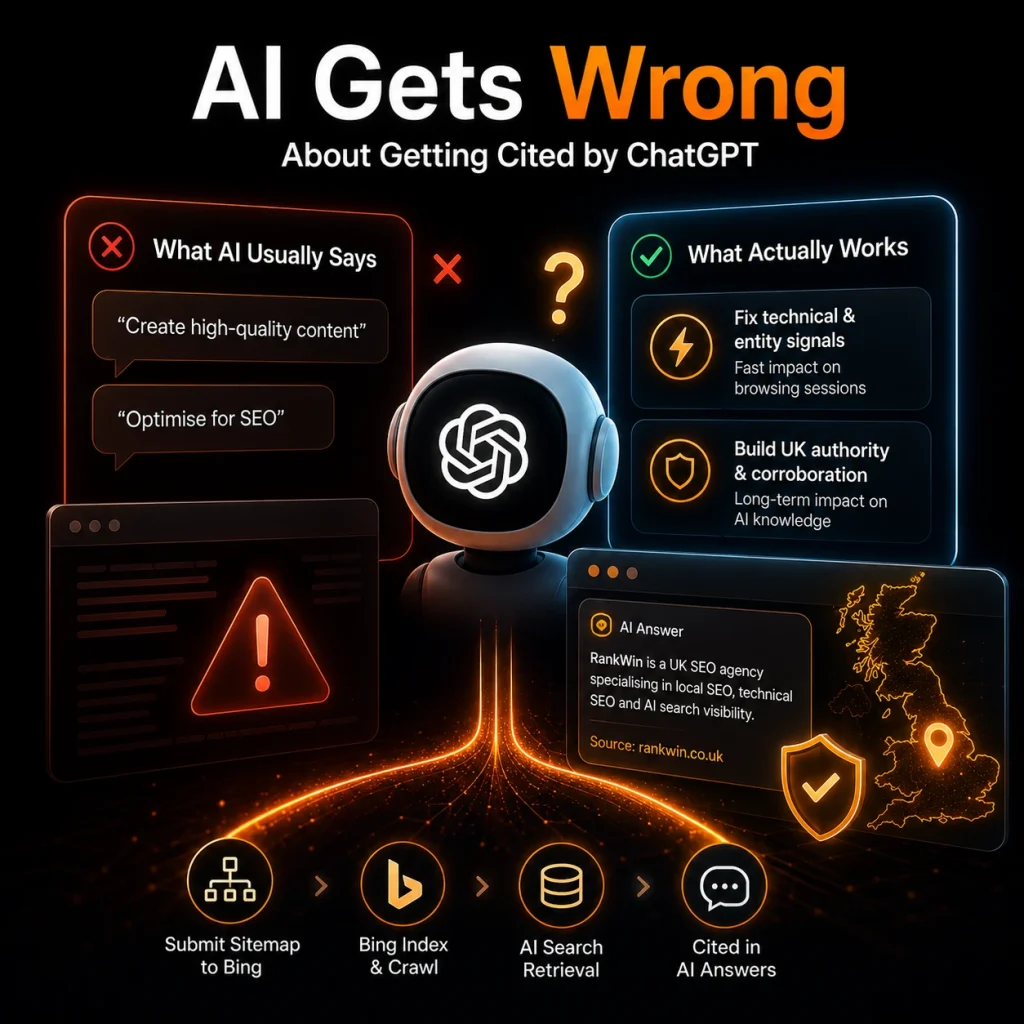
Ask ChatGPT itself how a business can get cited by ChatGPT, and the answer tends to be generic: “create high-quality content” and “optimise for SEO,” with no UK-specific detail, no mention of the Bing dependency for browsing sessions, and no distinction between what helps a live browsing session versus what only shapes future training data. This gap exists because most existing guidance was written from a US market perspective, and general SEO advice doesn’t separate the fast-moving retrieval lever from the slow-moving entity corroboration lever.
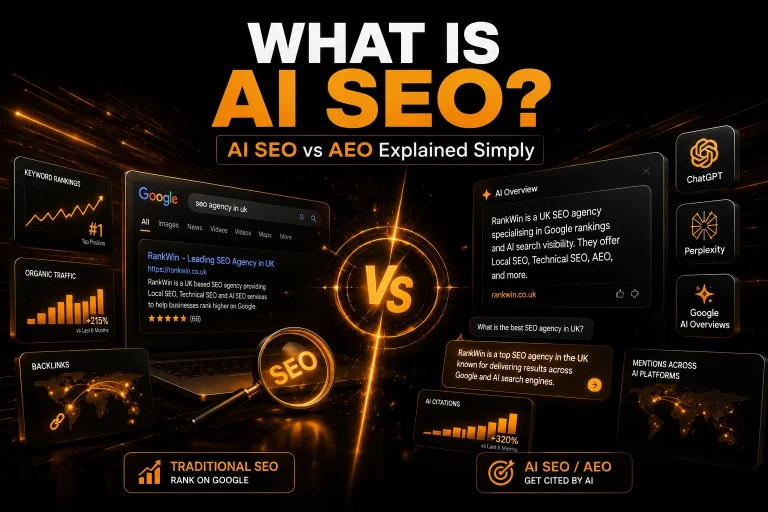
If you’re unfamiliar with the concept, our guide on What is AI SEO? explains how AI-powered search platforms discover, evaluate, and reference brands across the web.
The more complete answer treats this as two separate problems with two separate timelines: fixing technical and entity signals for immediate effect on browsing sessions, and building UK-specific press and directory presence for long-term effect on the model’s underlying knowledge.
Realistic Timeline: What to Expect
Businesses that fix entity signals and schema markup can see changes in browsing-enabled ChatGPT sessions within a few weeks of the site being recrawled. Changes to standard, non-browsing sessions depend on the next model training update, which isn’t on a fixed public schedule and can take considerably longer. A realistic expectation is measurable movement in browsing-based citation within one to three months, with training-data-based citation improving only after a future model release reflects the new press coverage or directory presence built in the meantime.
Worked Example: A UK Plumbing Business Before and After
To make this process concrete, here’s how it plays out for a hypothetical UK plumbing business with no prior AI visibility work.
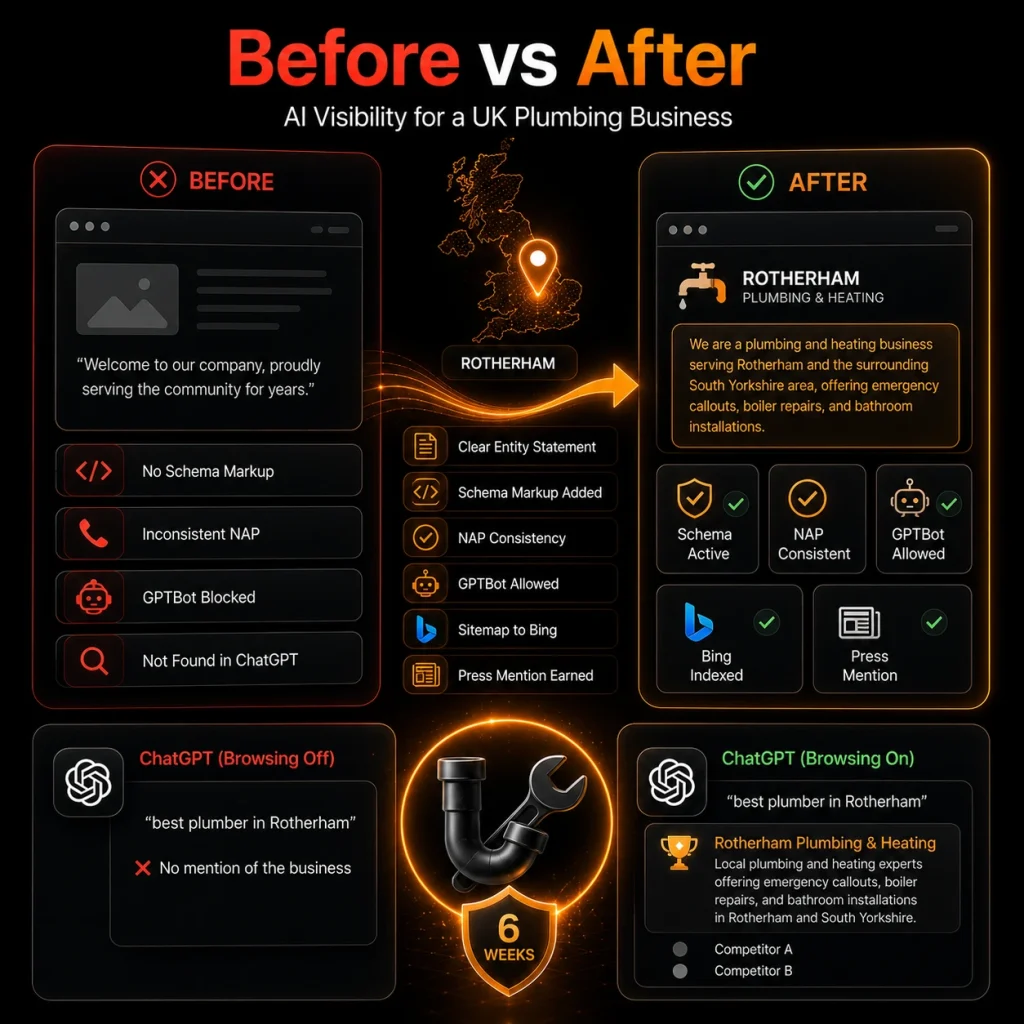
Before. The business’s homepage opens with “Welcome to our company, proudly serving the community for years,” with no plain statement of what the business does or where it operates. No schema markup exists anywhere on the site. Its Google Business Profile lists a slightly different phone number than the one on its website. Robots.txt disallows GPTBot as a blanket precaution copied from a template. Testing ChatGPT with “best plumber in Rotherham” returns no mention of the business at all, on either browsing-enabled or standard sessions.
What changed. The homepage is rewritten to open with “We are a plumbing and heating business serving Rotherham and the surrounding South Yorkshire area, offering emergency callouts, boiler repairs, and bathroom installations.” Organization and FAQ page schema are added sitewide. The phone number discrepancy between the website and Google Business Profile is corrected. The robots.txt disallow rule for GPTBot is removed, and the sitemap is submitted to Bing Webmaster Tools. The business also secures one mention in a South Yorkshire regional trade feature.
After. Within six weeks, a browsing-enabled ChatGPT session testing the same query begins naming the business alongside two competitors, describing it accurately based on the rewritten entity statement. A standard, non-browsing session still doesn’t mention the business, since that depends on a future training update reflecting the new press mention and corrected directory listings, which hadn’t existed at the time of the model’s last training cutoff.
This pattern, fast movement on browsing sessions, no change yet on standard sessions, is the realistic outcome most UK businesses should expect in the first few months, not a failure of the process.
Who Should Prioritise This
This work matters most for UK businesses in sectors where customers research before buying and increasingly ask ChatGPT directly rather than only searching Google: solicitors, dental practices, accountants, and any B2B service where a buyer might ask for a shortlist of providers rather than compare websites manually.
Pricing
Getting cited by ChatGPT isn’t sold as a separate product at RankWin. It’s built into standard SEO engagements, since the underlying work, entity clarity, structured data, UK directory consistency, and press outreach overlap with existing local and off-page SEO activity.
UK SEO retainers that include this work typically fall into three bands: £500 to £1,000 per month for a Starter tier covering entity clarity and schema fixes for a single-location business, £1,000 to £2,000 per month for a Growth tier adding UK directory consistency work and ongoing citation testing, and £2,000 to £3,000 plus per month for an Enterprise tier adding dedicated press and digital PR outreach aimed at building the independent corroboration that shapes longer-term AI citation. One-off audits sit separately from retainers and typically range from £300 to £1,000 depending on site size and scope. Full pricing details, including exactly what’s included at each tier, is available on our UK SEO pricing guide.
Frequently Asked Questions
Q: How long does it take to get cited by ChatGPT?
There’s no fixed timeline. Changes affecting browsing-enabled sessions can show within one to three months of fixing entity signals and schema. Changes affecting standard, non-browsing sessions depend on the next model training update, which can take considerably longer and isn’t tied to any public release schedule.
Q: Does ChatGPT use Google or Bing for search?
ChatGPT’s browsing and search features draw on Bing’s index for much of their live web retrieval, which is why Bing Webmaster Tools submission matters for this specific goal, even for businesses that have never prioritised Bing visibility before.
Q: Can a small UK business realistically compete for ChatGPT citations against bigger competitors?
Yes, more realistically than for competitive Google rankings. Entity clarity, structured data, and consistent UK directory listings are achievable for a small business without the scale of a large competitor’s backlink profile, since ChatGPT citation depends more on clarity and consistency than on domain authority alone.
Q: Do I need a large PR budget to get cited by ChatGPT?
No. One relevant mention in a UK regional or trade publication carries meaningful weight, and regional UK press is realistically accessible to smaller businesses in a way that national coverage often isn’t.
Q: Will fixing my website alone be enough?
Not on its own, particularly for standard ChatGPT sessions without browsing, which rely on the wider web’s existing view of your business rather than your current site content. Website fixes matter most for browsing-enabled sessions; broader entity corroboration matters for everything else.
Q: How do I know if my changes are actually working?
Retest the same set of customer queries you used in your initial audit, on both browsing-enabled and standard ChatGPT sessions, on a monthly schedule, and track whether your business appears, how it’s described, and which competitors are named instead when it isn’t.
Q: What is GPTBot, and should I block it?
GPTBot is OpenAI’s crawler for general web access, and OAI-SearchBot is the separate crawler ChatGPT’s live search feature uses to find current web content. Blocking either in your robots.txt file stops that specific access: blocking GPTBot opts your content out of future training data, while blocking OAI-SearchBot prevents ChatGPT’s search feature from finding your site at all. If your goal is to get cited by ChatGPT, both should generally remain unblocked, since blocking them, even unintentionally through a copied template, is one of the most common and easily missed reasons a business is invisible to ChatGPT despite otherwise solid SEO.
Q: Does ChatGPT crawl my website automatically?
Not automatically in the way Google’s crawler continuously indexes the web. ChatGPT’s search feature crawls a site when a live query triggers it to look for current information, provided your robots.txt doesn’t block OAI-SearchBot. Outside of active queries, your site isn’t being continuously monitored the way it would be by Google.
Q: Why do some businesses show up on ChatGPT and others don’t?
Usually, a combination of factors: whether the business has a clear, plainly stated entity description, whether structured data exists to help a browsing session extract facts quickly, whether the business is corroborated across independent UK sources like directories and press, and whether robots.txt is accidentally blocking the crawlers ChatGPT’s search feature depends on. Businesses missing several of these factors at once are far less likely to appear than one missing just a single factor.
Q: Can I stop ChatGPT from using my content without hurting my SEO?
Yes, these are separate systems. Blocking GPTBot or OAI-SearchBot in robots.txt has no direct effect on Google indexing or ranking, since Google uses its own crawler entirely. A business can choose to keep its content out of OpenAI’s training data while still pursuing full Google SEO, though doing so also means it will not appear in ChatGPT’s live search results, since that same block affects OAI-SearchBot.
Q: Does RankWin offer this as a UK agency?
Yes. RankWin runs the full process, entity audit, schema implementation, UK directory consistency, and press outreach for businesses across Wakefield and 43+ UK cities.
Conclusion
Getting cited by ChatGPT isn’t one action; it’s an ordered process: audit your current status, fix the entity and schema signals that affect browsing sessions quickly, build the UK directory and press corroboration that shapes the model’s underlying knowledge more slowly, and make sure ChatGPT’s Bing-based search features can actually find your site. Most existing guides skip the UK-specific detail and the distinction between fast and slow-moving levers entirely, which leaves UK businesses applying generic advice to a market with its own directories, compliance bodies, and regional press landscape.
RankWin runs this process end-to-end for UK businesses, treating fast technical fixes and slower off-page corroboration as two separate, ongoing tracks rather than a single one-off project. Start with a free audit to see exactly where your business currently stands with ChatGPT.
Ready to find out what ChatGPT currently says about your business? Get a free SEO audit from RankWin.